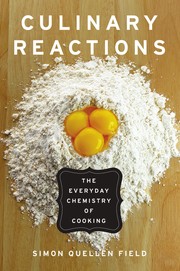
How long does it take to read Culinary Reactions?
Simon Field
Culinary Reactions by Simon Field takes about 4 hours 22 minutes to read at 250 words a minute.
About 4 hours 22 minutes
A weekend read
First published 2012. 238 pages, about 65,450 words.
9 days at 30 minutes a day
Estimate based on 275 words per page.
At other speeds
| Slow, 150 words a minute | 7 hours 16 minutes |
| Average, 250 words a minute | 4 hours 22 minutes |
| Fast, 400 words a minute | 2 hours 44 minutes |
The page count is the median across 1 edition, so your copy may differ. How we calculate.
About the book
"When you're cooking, you're a chemist! Every time you follow or modify a recipe you are experimenting with acids and bases, emulsions and suspensions, gels and foams. In your kitchen you denature proteins, crystallize compounds, react enzymes with substrates, and nurture desired microbial life while suppressing harmful microbes. And unlike in a laboratory, you can eat your experiments to verify your hypotheses. In Culinary Reactions, author Simon Field explores the chemistry behind the recipes you follow every day. How does altering the ratio of flour, sugar, yeast, salt, butter, and water affect how high bread rises? Why is whipped cream made with nitrous oxide rather than the more common carbon dioxide? And why does Hollandaise sauce fall for "clarified" butter? This easy-to-follow primer even includes recipes to demonstrate the concepts being discussed, including Whipped Creamsicle Topping (a foam), Cherry Dream Cheese (a protein gel), and Lemonade with Chameleon Eggs (an acid indicator). It even shows you how to extract DNA from a Halloween pumpkin. You'll never look at your graduated cylinders, Bunsen burners, and beakers. er, measuring cups, stovetop burners, and mixing bowls. the same way again"-- "When you're cooking, you're a chemist! Every time you follow or modify a recipe, you are experimenting with acids and bases, emulsions and suspensions, gels and foams. In your kitchen you denature proteins, crystallize compounds, react enzymes with substrates, and nurture desired microbial life while suppressing harmful microbes. And unlike in a laboratory, you can eat your experiments to verify your hypotheses. In CULINARY REACTIONS, author Simon Field explores the chemistry behind the recipes you follow every day. How does altering the ratio of flour, sugar, yeast, salt, butter, and water affect how high bread rises? Why is whipped cream made with nitrous oxide rather than the more common carbon dioxide? And why does Hollandaise sauce call for "clarified"…
Subjects: COOKING / Reference, COOKING / Essays, Food, SCIENCE / Chemistry / General, Cooking, Analysis