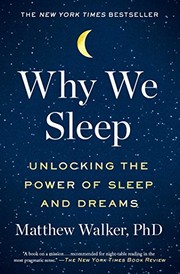
How long does it take to read Why We Sleep?
Matthew P. Walker, Matthew Walker
Why We Sleep by Matthew P. Walker, Matthew Walker takes about 6 hours 45 minutes to read at 250 words a minute.
About 6 hours 45 minutes
A weekend read
First published 2017. 368 pages, about 101,200 words.
14 days at 30 minutes a day
Estimate based on 275 words per page.
At other speeds
| Slow, 150 words a minute | 11 hours 15 minutes |
| Average, 250 words a minute | 6 hours 45 minutes |
| Fast, 400 words a minute | 4 hours 13 minutes |
The page count is the median across 11 editions, so your copy may differ. How we calculate.
About the book
With two appearances on CBS This Morning and Fresh Air's most popular interview of 2017, Matthew Walker has made abundantly clear that sleep is one of the most important but least understood aspects of our life. Until very recently, science had no answer to the question of why we sleep, or what good it served, or why we suffer such devastating health consequences when it is absent. Compared to the other basic drives in life—eating, drinking, and reproducing—the purpose of sleep remains more elusive. Within the brain, sleep enriches a diversity of functions, including our ability to learn, memorize, and make logical decisions. It recalibrates our emotions, restocks our immune system, fine-tunes our metabolism, and regulates our appetite. Dreaming creates a virtual reality space in which the brain melds past and present knowledge, inspiring creativity. In this “compelling and utterly convincing” (The Sunday Times) book, preeminent neuroscientist and sleep expert Matthew Walker provides a revolutionary exploration of sleep, examining how it affects every aspect of our physical and mental well-being. Charting the most cutting-edge scientific breakthroughs, and marshalling his decades of research and clinical practice, Walker explains how we can harness sleep to improve learning, mood and energy levels, regulate hormones, prevent cancer, Alzheimer’s and diabetes, slow the effects of aging, and increase longevity. He also provides actionable steps towards getting a better night’s sleep every night.
Subjects: sleep, health & fitness, sleep & sleep disorders, science, life sciences, Human Anatomy & Physiology