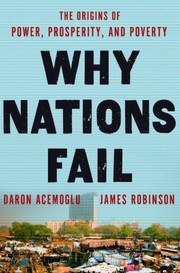
How long does it take to read Why Nations Fail?
The Origins of Power, Prosperity and Poverty
Daron Acemoglu, James A. Robinson
Why Nations Fail by Daron Acemoglu, James A. Robinson takes about 9 hours 42 minutes to read at 250 words a minute.
About 9 hours 42 minutes
A week or two of reading
First published 2012. 529 pages, about 145,475 words.
20 days at 30 minutes a day
Estimate based on 275 words per page.
At other speeds
| Slow, 150 words a minute | 16 hours 10 minutes |
| Average, 250 words a minute | 9 hours 42 minutes |
| Fast, 400 words a minute | 6 hours 4 minutes |
The page count is the median across 15 editions, so your copy may differ. How we calculate.
About the book
Why are some nations rich and others poor, divided by wealth and poverty, health and sickness, food and famine? Is it culture, the weather, or geography that determines prosperity or poverty? As Why Nations Fail shows, none of these factors is either definitive or destiny. Drawing on fifteen years of original research, Daron Acemoglu and James Robinson conclusively show that it is our man-made political and economic institutions that underlie economic success (or the lack of it). Korea, to take just one example, is a remarkably homogeneous nation, yet the people of North Korea are among the poorest on earth while their brothers and sisters in South Korea are among the richest. The differences between the Koreas is due to the politics that created those two different institutional trajectories. Acemoglu and Robinson marshal extraordinary historical evidence from the Roman Empire, the Mayan city-states, the Soviet Union, the United States, and Africa to build a new theory of political economy with great relevance for the big questions of today, among them: Will China's economy continue to grow at such a high speed and ultimately overwhelm the West? Are America's best days behind it? Are we creating a vicious cycle that enriches and empowers a small minority?
Subjects: Revolutions, Economic development, Economics, Social policy, Poverty, Economic policy