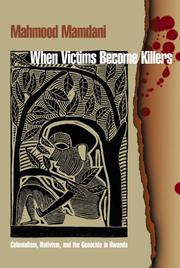
How long does it take to read When Victims Become Killers?
colonialism, nativism and the genocide in Rwanda
When Victims Become Killers by Mahmood Mamdani takes about 7 hours 2 minutes to read at 250 words a minute.
About 7 hours 2 minutes
A weekend read
First published 2001. 384 pages, about 105,600 words.
15 days at 30 minutes a day
Estimate based on 275 words per page.
At other speeds
| Slow, 150 words a minute | 11 hours 44 minutes |
| Average, 250 words a minute | 7 hours 2 minutes |
| Fast, 400 words a minute | 4 hours 24 minutes |
The page count is the median across 8 editions, so your copy may differ. How we calculate.
About the book
"Rejecting easy explanations of the genocide as a mysterious evil force that was bizarrely unleashed, one of Africa's best-known intellectuals situates the tragedy in its proper context. He coaxes to the surface the historical, geographical, and political forces that made it possible for so many Hutu to turn so brutally on their neighbors. He finds answers in the nature of political identities generated during colonialism, in the failures of the nationalist revolution to transcend these identities, and in regional demographic and political currents that reach well beyond Rwanda. In so doing, Mahmood Mamdani broadens understanding of citizenship and political identity in postcolonial Africa." "Mamdani's analysis provides a foundation for future studies of the massacre. His answers point a way out of crisis: a direction for reforming political identity in central Africa and preventing future tragedies."--Jacket. "Rejecting easy explanations of the genocide as a mysterious evil force that was bizarrely unleashed, one of Africa's best-known intellectuals situates the tragedy in its proper context. He coaxes to the surface the historical, geographical, and political forces that made it possible for so many Hutu to turn so brutally on their neighbors. He finds answers in the nature of political identities generated during colonialism, in the failures of the nationalist revolution to transcend these identities, and in regional demographic and political currents that reach well beyond Rwanda. In so doing, Mahmood Mamdani broadens understanding of citizenship and political identity in postcolonial Africa.". "Mamdani's analysis provides a foundation for future studies of the massacre. His answers point a way out of crisis: a direction for reforming political identity in central Africa and preventing future tragedies."--BOOK JACKET.
Subjects: Politics and government, Hutu (African people), Insurgency, Ethnic relations, Tutsi (African people), Genocide