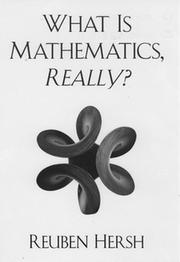
How long does it take to read What Is Mathematics, Really??
What Is Mathematics, Really? by Reuben Hersh takes about 6 hours 17 minutes to read at 250 words a minute.
About 6 hours 17 minutes
A weekend read
First published 1997. 343 pages, about 94,325 words.
13 days at 30 minutes a day
Estimate based on 275 words per page.
At other speeds
| Slow, 150 words a minute | 10 hours 29 minutes |
| Average, 250 words a minute | 6 hours 17 minutes |
| Fast, 400 words a minute | 3 hours 56 minutes |
The page count is the median across 7 editions, so your copy may differ. How we calculate.
About the book
Virtually all philosophers treat mathematics as isolated, timeless, ahistorical, inhuman. In What Is Mathematics, Really? renowned mathematician Reuben Hersh argues the contrary. In a subversive attack on traditional philosophies of mathematics, most notably Platonism and formalism, he shows that mathematics must be understood as a human activity, a social phenomenon, part of human culture, historically evolved, and intelligible only in a social context. Mathematical objects are created by humans, not arbitrarily, but from activity with existing mathematical objects, and from the needs of science and daily life. Hersh pulls the screen back to reveal mathematics as seen by professionals, debunking many mathematical myths, and demonstrating how the "humanist" idea of the nature of mathematics more closely resembles how mathematicians actually work. The humanist standpoint helps him to resolve ancient controversies about proof, certainty, and invention versus discovery. The second half of the book provides a fascinating history of the "mainstream" of philosophy - ranging from Pythagoras, Plato, Descartes, Spinoza, and Kant, to Bertrand Russell, Hilbert, Carnap, and Quine. Then come the mavericks who saw mathematics as a human artifact - Aristotle, Locke, Hume, Mill, Peirce, Dewey, Wittgenstein. In his epilogue, Hersh reveals that this is no mere armchair debate, of little consequence to the outside world. Platonism and elitism fit together naturally. Humanism, on the other hand, links mathematics with people, with society, and with history. It fits with liberal anti-elitism and its historical striving for universal literacy, universal higher education, and universal access to knowledge and culture. Thus Hersh's argument has educational and political consequences.
Subjects: Mathematics, Philosophy, Mathe matiques - Philosophie, Mathematik, Philosophie, Mathe matiques