How long does it take to read Time Out of Joint?
Time Out of Joint by Philip K. Dick takes about 4 hours 13 minutes to read at 250 words a minute.
About 4 hours 13 minutes
A weekend read
First published 1959. 230 pages, about 63,250 words.
9 days at 30 minutes a day
Estimate based on 275 words per page.
At other speeds
| Slow, 150 words a minute | 7 hours 2 minutes |
| Average, 250 words a minute | 4 hours 13 minutes |
| Fast, 400 words a minute | 2 hours 38 minutes |
The page count is the median across 25 editions, so your copy may differ. How we calculate.
About the book
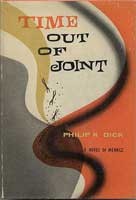
Time Out of Joint is a dystopian novel by American writer Philip K. Dick, first published in novel form in the United States in 1959. An abridged version was also serialised in the British science fiction magazine New Worlds Science Fiction in several installments from December 1959 to February 1960. The novel epitomizes many of Dick's themes with its concerns about the nature of reality and ordinary people in ordinary lives having the world unravel around them. The title is a reference to Shakespeare's play Hamlet. The line is uttered by Hamlet to Horatio after being visited by his father's ghost and learning that his uncle Claudius murdered his father; in short, a shocking supernatural event that fundamentally alters the way Hamlet perceives the state and the universe ("The time is out of joint; O cursed spite!/That ever I was born to set it right!" [I.V.211-2]), much as do several events in the novel. Ragle Gumm is an ordinary man leading an ordinary life, except that he makes his living by entering a newspaper contest every day -- and winning, every day. But he gradually begins to suspect that his life -- indeed his whole world -- is an illusion, constructed around him for the express purpose of keeping him docile and happy. But if that is the case, what is his real world like, and what is he actually doing every day when he thinks he is guessing 'Where Will The Little Green Man Be Next?'
Subjects: American Science fiction, Fiction, Psychological aspects, Psychological aspects of Puzzles, Puzzles, Science fiction, American