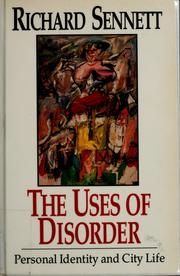
How long does it take to read The Uses of Disorder?
Personal Identity & City Life
The Uses of Disorder by Richard Sennett takes about 3 hours 38 minutes to read at 250 words a minute.
About 3 hours 38 minutes
A weekend read
First published 1970. 198 pages, about 54,450 words.
8 days at 30 minutes a day
Estimate based on 275 words per page.
At other speeds
| Slow, 150 words a minute | 6 hours 3 minutes |
| Average, 250 words a minute | 3 hours 38 minutes |
| Fast, 400 words a minute | 2 hours 16 minutes |
The page count is the median across 18 editions, so your copy may differ. How we calculate.
About the book
The excitement of the brilliantly innovative book is that it challenges the reader to revise his concept of order—and to consider the seemingly disparate problems of the individual personality and the urban society in the light of a fresh, unified framework that has the shock of new truth. Drawing on recent ideas in psychology, sociology, and urban history, Sennett shows how the excessively “ordered” community freezes adults—both the fierce young idealists and their security-oriented parents—into rigid attitudes that originate in adolescence and stifle further personal growth. He explains how the accepted ideal of order generates patterns of behavior among the urban middle cases that are stultifying, narrow, and violence-prone. He demonstrates that most city planning has been conducted with the same rigidity, and shows, in specific and human terms, why that approach has not solved and cannot solve our cities problems. The Uses of Disorder is not only a critique of the ways in which the affluent city has failed as a place where the individual—even the affluent individual—can grow. It is also an exploration of new modes of urban organization through which city life can become richer and more life-affirming. The author proposes and projects in concrete terms (including a new use of the police) a functioning city that can incorporate anarchy, diversity, and creative disorder to bring into being adults who can openly respond to and dealt with the challenges of life. Thus, Richard Sennett, more aware of the nature of human nature than most Utopians of the past, sees progress in the creation of new urban relationships that will protect, not stability, but diversity and change. Out of his books, with its free and imaginative insights grounded in a strong sense of present-day realities, emerges the vision of a fully affluent and libertarian society—an arena that will welcome a rich variety of individuals, and accept the conflict that stem from such variety as not merely…
Subjects: Cities and towns, Community life, Long Now Manual for Civilization, Social Conformity, Stadtplanung, Lebensqualität