How long does it take to read The Salem Witch Hunt?
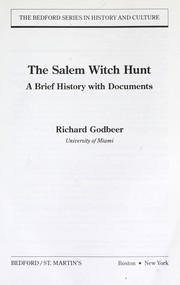
The Salem Witch Hunt by Richard Godbeer takes about 3 hours 54 minutes to read at 250 words a minute.
About 3 hours 54 minutes
A weekend read
First published 2011. 213 pages, about 58,575 words.
8 days at 30 minutes a day
Estimate based on 275 words per page.
At other speeds
| Slow, 150 words a minute | 6 hours 31 minutes |
| Average, 250 words a minute | 3 hours 54 minutes |
| Fast, 400 words a minute | 2 hours 26 minutes |
The page count is the median across 4 editions, so your copy may differ. How we calculate.
About the book
The Salem witch trials stand as one of the infamous moments in colonial American history. More than 150 people -- primarily women -- from 24 communities were charged with witchcraft; 19 were hanged and others died in prison. In his introduction to this compact yet comprehensive volume, Richard Godbeer explores the beliefs, fears, and historical context that fueled the witch panic of 1692. The documents in this collection illuminate how the Puritans' worldview led them to seek a supernatural explanation for the problems vexing their community. Presented as case studies, the carefully chosen records from several specific trials offer a clear picture of the gender norms and social tensions that underlie the witchcraft accusations. The final documents cover recantations of confessions, the aftermath of the witch hunt, and statements of regret. A chronology of the witchcraft crisis, questions for consideration, and a selected bibliography round out the book's pedagogical support.The Salem witch trials stand as one of the infamous moments in colonial American history. More than 150 people -- primarily women -- from 24 communities were charged with witchcraft; 19 were hanged and others died in prison. In his introduction to this compact yet comprehensive volume, Richard Godbeer explores the beliefs, fears, and historical context that fueled the witch panic of 1692. The documents in this collection illuminate how the Puritans' worldview led them to seek a supernatural explanation for the problems vexing their community. Presented as case studies, the carefully chosen records from several specific trials offer a clear picture of the gender norms and social tensions that underlie the witchcraft accusations. The final documents cover recantations of confessions, the aftermath of the witch hunt, and statements of regret. A chronology of the witchcraft crisis, questions for consideration, and a selected bibliography round out the book's pedagogical support.
Subjects: Trials (Witchcraft), Social conditions, History, Witchcraft, Hunting, united states, Sorcellerie