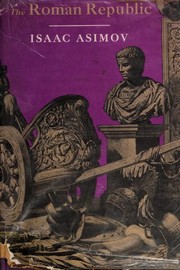
How long does it take to read The Roman Republic?
The Roman Republic by Isaac Asimov takes about 4 hours 45 minutes to read at 250 words a minute.
About 4 hours 45 minutes
A weekend read
First published 1966. 259 pages, about 71,225 words. Written for children.
10 days at 30 minutes a day
Estimate based on 275 words per page.
At other speeds
| Slow, 150 words a minute | 7 hours 55 minutes |
| Average, 250 words a minute | 4 hours 45 minutes |
| Fast, 400 words a minute | 2 hours 58 minutes |
The page count is the median across 9 editions, so your copy may differ. How we calculate.
About the book
If western civilization looks to ancient Greece for the source of its philosophical and aesthetic inspiration, it is still the Romans who have most influenced the shape of our daily lives, our ideals of justice and honor, our forms of government and our strivings for a world of peace and order. The Roman republic with its virtues of honest living, bravery, loyalty and fair play remains the model of our own republic, and the stories of its courageous citizen-soldiers (vividly colored by late Roman historians) were very much a part of the education of our own founding fathers. In this book, Isaac Asimov tells the history of a small semicivilized tribe who made a great dream of glory come true. Bold, fearless and supremely self-confident, the Romans outgrew their tiny domain on the Italian peninsula and in the space of 500 years created the most magnificent realm yet seen. For the only time in human history all the western world lived at peace. This great drive to conquest makes a stirring tale of heroes and battles both on the plains and mountains of distant lands and in the Roman senate itself, for vigorous politics were as great a source of strength to Rome as her invincible armies. Speaking of Dr. Asimov's history of Greece, Horn Book said, "The author has a remarkable ability- to breathe life into any subject he chooses to present, and his enthusiasm for all aspects of knowledge usually keeps high the level of interest. In its vitality this book is no exception, nor in its admirable simplicity and clarity."' The same is true of his further exploration into the history of Rome. This book stops with Rome at her most triumphant. The story of the empire that followed yet remains to be told.
Subjects: History, Rome, Ancient civilizations, Ancient Rome