How long does it take to read The Quantum and the Lotus?
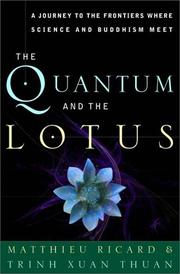
A Journey to the Frontiers Where Science and Buddhism Meet
Trinh Xuan Thuan
The Quantum and the Lotus by Trinh Xuan Thuan takes about 5 hours 52 minutes to read at 250 words a minute.
About 5 hours 52 minutes
A weekend read
First published 2001. 320 pages, about 88,000 words.
12 days at 30 minutes a day
Estimate based on 275 words per page.
At other speeds
| Slow, 150 words a minute | 9 hours 47 minutes |
| Average, 250 words a minute | 5 hours 52 minutes |
| Fast, 400 words a minute | 3 hours 40 minutes |
The page count is the median across 2 editions, so your copy may differ. How we calculate.
About the book
"Matthieu Ricard trained as a molecular biologist, working in the lab of a Nobel prize-winning scientist, but when he read some Buddhist philosophy, he became drawn to Buddhism. Eventually he left his life in science to study with Tibetan teachers, and he is now a Buddhist monk and translator for the Dalai Lama, living in the Shechen monastery near Kathmandu in Nepal. Trinh Thuan was born into a Buddhist family in Vietnam but became intrigued by the explosion of discoveries in astronomy during the 1960s. He made his way to the prestigious California Institute of Technology to study with some of the biggest names in the field and is now an acclaimed astrophysicist and specialist on how the galaxies formed.". "When Matthieu Ricard and Trinh Thuan met at an academic conference in the summer of 1997, they began discussing the many remarkable connections between the teachings of Buddhism and the findings of recent science. That conversation grew into an astonishing correspondence exploring a series of fascinating questions. Did the universe have a beginning? Or is our universe one in a series of infinite universes with no end and no beginning? Is the concept of a beginning of time fundamentally flawed? Might our perception of time in fact be an illusion, a phenomenon created in our brains that has no ultimate reality? Is the stunning fine-tuning of the universe, which has produced just the right conditions for life to evolve, a sign that a "principle of creation" is at work in our world? If such a principle of creation undergirds the workings of the universe, what does that tell us about whether or not there is a divine Creator? How does the radical interpretation of reality offered by quantum physics conform to and yet differ from the Buddhist conception of reality? What is consciousness and how did it evolve? Can consciousness exist apart from a brain generating it?". "The stimulating journey of discovery the authors traveled in their discussions is re-created…
Subjects: Buddhism, Enlightenment (Buddhism), Physics, Spiritual life, Buddhism and science, Religious aspects