How long does it take to read The Mathematical Universe?
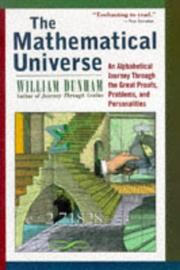
An Alphabetical Journey Through the Great Proofs, Problems, and Personalities
The Mathematical Universe by William Dunham takes about 6 hours 36 minutes to read at 250 words a minute.
About 6 hours 36 minutes
A weekend read
First published 1994. 360 pages, about 99,000 words.
14 days at 30 minutes a day
Estimate based on 275 words per page.
At other speeds
| Slow, 150 words a minute | 11 hours |
| Average, 250 words a minute | 6 hours 36 minutes |
| Fast, 400 words a minute | 4 hours 8 minutes |
The page count is the median across 7 editions, so your copy may differ. How we calculate.
About the book
From the simple elegance of the Pythagorean theorem to the looking-glass world of Russell's Paradox and the summed infinities of integral calculus, experience the beauty and majesty of the mathematical universe. William Dunham, author of the popular Journey Through Genius, will give you a rare sampling of its joys. Writing in his trademark razor-sharp style, Dunham introduces a tantalizing selection of the great proofs, notorious disputes, and intriguing unsolved mysteries. Subjects range from the golden age of Greek geometry to the furthest frontier of infinite series. In chapters spanning the field from A to Z, discover the marvels of the Monte Carlo Method and the ancient riddle of Dido's Problem. Scale the heights of the Himalayas with famed surveyor Sir George Everest and puzzle over the fascinating conundrum of Fermat's Last Theorem. Dunham explores more than five thousand years of mathematical history, digging into the earliest records in Egypt, Babylon, India, and China, and turning up surprising tales and tidbits from modern times. . All along the way, Dunham portrays the great masters of math at their work. In colorful anecdotes, the brilliant - often eccentric - luminaries chart the course of mathematical progress. Among them are the battling Bernoulli brothers, Jakob and Johann, who worked tirelessly to one-up each other's theorems; the famed Isaac Newton and largely forgotten Gottfried Wilhelm Leibniz, who independently and virtually simultaneously discovered "the calculus"; and the exceptionally determined genius Sofia Kovalevskaia, who discovered the rules of trigonometry for herself when she was left without instruction. Your passport to rich rewards, The Mathematical Universe is accessible to any reader with a basic knowledge of algebra and geometry. You will come away from this exhilarating book with a keen sense of the power and splendor of the magical mathematical world.
Subjects: Mathematics, Mathematicians, Biography, History, Mathematics, history, Mathematics, popular works