How long does it take to read The Longman Anthology of British Literature?
David Damrosch, Stuart Sherman, Christopher Baswell, Anne Howland Schotter, Constance Jordan, Clare Carroll, Susan J. Wolfson, Peter J. Manning, Heather Henderson, William Chapman Sharpe, Kevin J. H. Dettmar, Jennifer Wicke
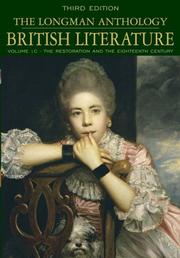
The Longman Anthology of British Literature by David Damrosch, Stuart Sherman, Christopher Baswell, Anne Howland Schotter, Constance Jordan, Clare Carroll, Susan J. Wolfson, Peter J. Manning, Heather Henderson, William Chapman Sharpe, Kevin J. H. Dettmar, Jennifer Wicke takes about 19 hours 47 minutes to read at 250 words a minute.
About 19 hours 47 minutes
A long haul
First published 2005. 1,079 pages, about 296,725 words.
40 days (about 6 weeks) at 30 minutes a day
Estimate based on 275 words per page.
At other speeds
| Slow, 150 words a minute | 32 hours 58 minutes |
| Average, 250 words a minute | 19 hours 47 minutes |
| Fast, 400 words a minute | 12 hours 22 minutes |
The page count is the median across 8 editions, so your copy may differ. How we calculate.
About the book
Literature has a double life. Born in one time and place and read in another, literary works are at once products of their age and independent creations, able to live on long after their original world has disappeared. The goal of this anthology is to present a wealth of poetry, prose, and drama from the full sweep of the literary history of Great Britain and its empire, and to do so in ways that will bring out both the works’ original cultural contexts and their lasting aesthetic power. These aspects are, in fact, closely related: Form and content, verbal music and social meanings, go hand in hand. This double life makes literature, as Aristotle said, “the most philosophical” of all the arts, intimately connected to ideas and to realities that the writer transforms into moving patterns of words. The challenge is to show these works in the contexts in which, and for which, they were written, while at the same time not trapping them within those contexts. The warm response this anthology has received from the hundreds of teachers who have adopted it in its first two editions reflects the growing consensus that we do not have to accept an “either/or” choice between the literature’s aesthetic and cultural dimensions. Our users’ responses have now guided us in seeing how we can improve our anthology further, so as to be most pleasurable and stimulating to students, most useful to teachers, and most responsive to ongoing developments in literary studies.
Subjects: Literary collections, Literary Criticism, Literature - Classics / Criticism, English, British Isles, English, Irish, Scottish, Welsh