How long does it take to read The Illegitimacy of Nationalism?
Ashis Nandy
The Illegitimacy of Nationalism by Ashis Nandy takes about 1 hour 43 minutes to read at 250 words a minute.
About 1 hour 43 minutes
An evening's read
First published 1994. 94 pages, about 25,850 words.
4 days at 30 minutes a day
Estimate based on 275 words per page.
At other speeds
| Slow, 150 words a minute | 2 hours 52 minutes |
| Average, 250 words a minute | 1 hour 43 minutes |
| Fast, 400 words a minute | 1 hour 5 minutes |
The page count is the median across 2 editions, so your copy may differ. How we calculate.
About the book
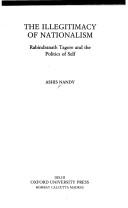
Nandy, Ashis. The Illegitimacy of Nationalism: Rabindranath Tagore and the Politics of Self. Delhi, Oxford University Press, 1994. Summary: In this book, one of India’s (some might say, of the world’s) most eminent intellectuals sets out to examine the anti-nationalist thinking of a "dissenter among dissenters," the Nobel Prize-winning Bengali poet, novelist, and moral figure, whom Gandhi called gurudev, "great teacher": Rabindranath Tagore (b. 1861—d. 1941). This double dissidence calls for elucidation. According to Nandy, in the golden age of the Indian freedom movement, many of the leading actors in that movement had become ambivalent about nationalism, associating it with the rapine and violence of colonialism. Most of these antinationalist freedom-activists believed that nationalism was a premodern artifact that would melt into air as soon as the principles of the Enlightenment were embraced. But a small band, Nandy contends, saw nationalism as being rather the inevitable by-product of modernity, and wanted nothing to do with the homogeneous universalism that was proffered as a solution to the problem. "Their alternative," he says, "was a distinctive civilizational concept of universalism embedded in the tolerance encoded in various traditional ways of life in a highly diverse, plural society" (xi). Nandy sees Rabindranath Tagore as being one of the proponents of this heterogeneous approach to modernity and the pathologies of nationalism. The essay "explores, mainly through an analysis of the three explicitly political novels Tagore wrote, the political passions and philosophical awareness which pushed him towards a dissident concept of national ideology" (3). In Chapter One, "The Ideology," Nandy positions Tagore as the high-culture modernist (who was nonetheless a sharp critic of modernity) to Gandhi’s low-culture antimodernist (who nonetheless found much between the cracks of the modernity monolith that was worth celebrating). He then discusses the main…
Subjects: Nationalism, Political and social views, Self (philosophy), India, politics and government