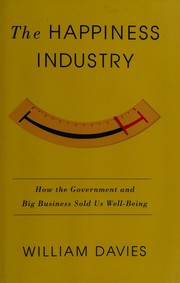
How long does it take to read The Happiness Industry?
William Davies
The Happiness Industry by William Davies takes about 5 hours 45 minutes to read at 250 words a minute.
About 5 hours 45 minutes
A weekend read
First published 2015. 314 pages, about 86,350 words.
12 days at 30 minutes a day
Estimate based on 275 words per page.
At other speeds
| Slow, 150 words a minute | 9 hours 36 minutes |
| Average, 250 words a minute | 5 hours 45 minutes |
| Fast, 400 words a minute | 3 hours 36 minutes |
The page count is the median across 1 edition, so your copy may differ. How we calculate.
About the book
"In winter 2014, a Tibetan monk lectured the world leaders gathered at Davos on the importance of Happiness. The recent DSM-5, the manual of all diagnosable mental illnesses, for the first time included shyness and grief as treatable diseases. Happiness has become the biggest idea of our age, a new religion dedicated to well-being. In this brilliant dissection of our times, political economist William Davies shows how this philosophy, first pronounced by Jeremy Bentham in the 1780s, has dominated the political debates that have delivered neoliberalism. From a history of business strategies of how to get the best out of employees, to the increased level of surveillance measuring every aspect of our lives; from why experts prefer to measure the chemical in the brain than ask you how you are feeling, to why Freakonomics tells us less about the way people behave than expected, The Happiness Industry is an essential guide to the marketization of modern life. Davies shows that the science of happiness is less a science than an extension of hyper-capitalism"-- "When Jeremy Bentham proposed that government should run 'for the greatest benefit of the greatest number,' he posed two problems: what is happiness and how can we measure it? With the rise of positive psychology, freakonomics, behavioural economics, endless TED talks, the happiness manifesto, the Happiness Index, the tyranny of customer service, the emergence of the quantified self movement, we have become a culture obsessed with measuring our supposed satisfaction. In anecdotes that include the Buddhist monk who lectured the business leaders of the world at Davos, why the Nike Fuel band makes us more worried about our fitness, how parts of our city are being rebuilt in response to scientific studies of oxytocin levels in our brain, and what a survey from Radisson hotels--that proves that 62% of us believe that well-being is a luxury worth more than work or a good relationship--really tells us about the way we…
Subjects: Social aspects, Marketing, Economics, Capitalism, Well-being, Psychological aspects