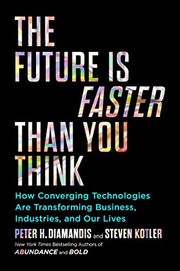
How long does it take to read The Future Is Faster Than You Think?
How Converging Technologies Are Transforming Business, Industries, and Our Lives
Peter H. Diamandis, Steven Kotler
The Future Is Faster Than You Think by Peter H. Diamandis, Steven Kotler takes about 7 hours 2 minutes to read at 250 words a minute.
About 7 hours 2 minutes
A weekend read
First published 2020. 384 pages, about 105,600 words.
15 days at 30 minutes a day
Estimate based on 275 words per page.
At other speeds
| Slow, 150 words a minute | 11 hours 44 minutes |
| Average, 250 words a minute | 7 hours 2 minutes |
| Fast, 400 words a minute | 4 hours 24 minutes |
The page count is the median across 5 editions, so your copy may differ. How we calculate.
About the book
The Future Is Faster Than You Think, is a blueprint for how our world will change in response to the next ten years of rapid technological disruption. Technology is accelerating far more quickly than anyone could have imagined. During the next decade, we will experience more upheaval and create more wealth than we have in the past hundred years. In this gripping and insightful roadmap to our near future, Diamandis and Kotler investigate how wave after wave of exponentially accelerating technologies will impact both our daily lives and society as a whole. What happens as AI, robotics, virtual reality, digital biology, and sensors crash into 3D printing, blockchain, and global gigabit networks? How will these convergences transform today's legacy industries? What will happen to the way we raise our kids, govern our nations, and care for our planet? Diamandis, a space-entrepreneur-turned-innovation-pioneer, and Kotler, bestselling author and peak performance expert, probe the science of technological convergence and how it will reinvent every part of our lives--transportation, retail, advertising, education, health, entertainment, food, and finance--taking humanity into uncharted territories and reimagining the world as we know it. As indispensable as it is gripping, The Future Is Faster Than You Think provides a prescient look at our impending future.
Subjects: Economic history, Technological forecasting, Technology, social aspects, Convergence (economics)