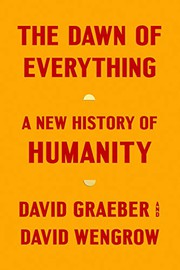
How long does it take to read The Dawn of Everything?
David Graeber, David Wengrow
The Dawn of Everything by David Graeber, David Wengrow takes about 12 hours 54 minutes to read at 250 words a minute.
About 12 hours 54 minutes
A week or two of reading
First published 2021. 704 pages, about 193,600 words.
26 days at 30 minutes a day
Estimate based on 275 words per page.
At other speeds
| Slow, 150 words a minute | 21 hours 31 minutes |
| Average, 250 words a minute | 12 hours 54 minutes |
| Fast, 400 words a minute | 8 hours 4 minutes |
The page count is the median across 19 editions, so your copy may differ. How we calculate.
About the book
The renowned activist and public intellectual David Graeber teams up with the professor of comparative archaeology David Wengrow to deliver a trailblazing account of human history, challenging our most fundamental assumptions about social evolution—from the development of agriculture and cities to the emergence of "the state," political violence, and social inequality—and revealing new possibilities for human emancipation For generations, our remote ancestors have been cast as primitive and childlike—either free and equal innocents, or thuggish and warlike. Civilization, we are told, could be achieved only by sacrificing those original freedoms or, alternatively, by taming our baser instincts. David Graeber and David Wengrow show how such theories first emerged in the eighteenth century as a conservative reaction to powerful critiques of European society posed by Indigenous observers and intellectuals. Revisiting this encounter has startling implications for how we make sense of human history today, including the origins of farming, property, cities, democracy, slavery, and civilization itself. Drawing on pathbreaking research in archaeology and anthropology, the authors show how history becomes a far more interesting place once we learn to throw off our conceptual shackles and perceive what’s really there. If humans did not spend 95 percent of their evolutionary past in tiny bands of hunter-gatherers, what were they doing all that time? If agriculture, and cities, did not mean a plunge into hierarchy and domination, then what kinds of social and economic organization did they lead to? What was really happening during the periods that we usually describe as the emergence of "the state"? The answers are often unexpected, and suggest that the course of human history may be less set in stone, and more full of playful, hopeful possibilities, than we tend to assume. The Dawn of Everything fundamentally transforms our understanding of the human past and offers a path…
Subjects: Civilization, history, Civilization, Philosophy, History, HISTORY, ANCIENT, Anthropology