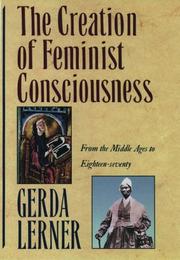
How long does it take to read The Creation of Feminist Consciousness?
From the Middle Ages to Eighteen-Seventy
The Creation of Feminist Consciousness by Gerda Lerner takes about 7 hours 46 minutes to read at 250 words a minute.
Book 2 of Women and History
Previous: The Creation of Patriarchy
About 7 hours 46 minutes
A weekend read
First published 1993. 424 pages, about 116,600 words.
16 days at 30 minutes a day
Estimate based on 275 words per page.
At other speeds
| Slow, 150 words a minute | 12 hours 57 minutes |
| Average, 250 words a minute | 7 hours 46 minutes |
| Fast, 400 words a minute | 4 hours 52 minutes |
The page count is the median across 5 editions, so your copy may differ. How we calculate.
About the book
A pioneer in women's studies and long-term activist for women's issues, and a past president of the Organization of American Historians, Gerda Lerner is one of the founders and foremost scholars of Women's History. The Creation of Patriarchy, the first book in her two-volume magnum opus Women and History (1986) received wide review attention and much acclaim, winning the prestigious Joan Kelly Prize of the American Historical Association for the best work on Women's History that year. Ms hailed the book for providing "a grand historical framework that was impossible even to imagine before the enlightenment about women's place in the world provided by her earlier work and that of other feminist scholars." New Directions for Women said it "may well be the most important work in feminist theory to appear in our generation." Patriarchy traced the development of the ideas, symbols, and metaphors by which men institutionalized their domination of women. Now, in The Creation of Feminist Consciousness, the eagerly awaited concluding volume of Women and History, Lerner documents the twelve-hundred-year struggle of women to free their minds from patriarchal thought, to create Women's History, and to achieve a feminist consciousness. In a richly documented narrative filled with inspiring portraits of women, Lerner ranges from the Middle Ages to the late 19th century, tracing several important ways by which women strove for autonomy and equality. One of the most remarkable sections examines over twelve hundred years of feminist Bible criticism. Since objections to women's thinking, teaching, and speaking in public were based on biblical authority-most notably, passages from Genesis and the writings of St. Paul-women returned again and again to these texts, in an attempt to subvert patriarchal dominance and establish their equality with men. This survey of biblical criticism allows Lerner to illustrate her most important insight.
Subjects: Civilization, Western, Feminist theory, History, Western Civilization, Women, Women intellectuals