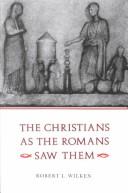
How long does it take to read The Christians as the Romans Saw Them?
Robert Louis Wilken
The Christians as the Romans Saw Them by Robert Louis Wilken takes about 3 hours 55 minutes to read at 250 words a minute.
About 3 hours 55 minutes
A weekend read
First published 1984. 214 pages, about 58,850 words.
8 days at 30 minutes a day
Estimate based on 275 words per page.
At other speeds
| Slow, 150 words a minute | 6 hours 32 minutes |
| Average, 250 words a minute | 3 hours 55 minutes |
| Fast, 400 words a minute | 2 hours 27 minutes |
The page count is the median across 3 editions, so your copy may differ. How we calculate.
About the book
From Pliny the Younger (d. 113) to Julian the Apostate (d. 363): a well-written, well-organized, and generally helpful survey of what pagan critics said about Christianity. Wilken (History, Notre Dame) has no new material to offer--most anti-Christian propaganda has been lost or deliberately destroyed by the Church, and much of what survives is found in fragments quoted by Christian apologists--but he puts the work of major controversialists like Celsus and Porphyry into fresh and sometimes illuminating perspective. Instead of treating these polemical texts in the usual fashion, as footnotes to early Christian history, Wilken regards them as evidence of an important dialectical critique that was thoughtful (not mere scandal-mongering, or satire à la Lucian), measured (Galen acknowledged the moral seriousness of Christians even while deploring their irrational dogmatism), and often telling. (Porphyry's argument that the Book of Daniel contains images of Antiochus Epiphanes IV's persecution of the Jews, not prophecies of Jesus' coming, is now a commonplace of biblical exegesis.) Wilken shows how pagan reactions evolved over 2(apple) centuries: early writers such as Tacitus and Pliny had only sketchy notions of Christianity, while their successors studied the New Testament with some care, and Julian had actually been a Christian. And he points out that many of their objections--e.g., Porphyry's, that Jesus was just another heroic sage--are alive and well today. He not only presents the pagans sympathetically, indeed, he seems at times to be cheering them on--as when, echoing Julian's Contra Galilaeos, he dismisses Christian claims to any significant share in Jewish tradition as a ""silly idea."" Wilken is most interesting when he has sociological data to draw on (resemblances between the Church and pious non-Christian burial societies), least interesting when merely paraphrasing a philosophical text (Celsus' True Doctrine, for example.) But all in all a fine…
Subjects: History and criticism, Christianity, Primitive and early church, Christentum, Interfaith relations, Romans