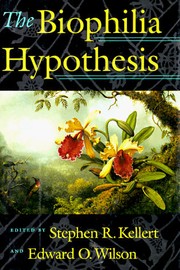
How long does it take to read The Biophilia Hypothesis?
Stephen R. Kellert, Edward O. Wilson
The Biophilia Hypothesis by Stephen R. Kellert, Edward O. Wilson takes about 8 hours 59 minutes to read at 250 words a minute.
About 8 hours 59 minutes
A week or two of reading
First published 1993. 490 pages, about 134,750 words.
18 days at 30 minutes a day
Estimate based on 275 words per page.
At other speeds
| Slow, 150 words a minute | 14 hours 58 minutes |
| Average, 250 words a minute | 8 hours 59 minutes |
| Fast, 400 words a minute | 5 hours 37 minutes |
The page count is the median across 2 editions, so your copy may differ. How we calculate.
About the book
"Biophilia" is the term coined by Edward O. Wilson to describe what he believes is humanity's innate affinity for the natural world. In his landmark book Biophilia, he examined how our tendency to focus on life and lifelike processes might be a biologically based need, integral to our development as individuals and as a species. That idea has caught the imagination of diverse thinkers.The Biophilia Hypothesis brings together the views of some of the most creative scientists of our time, each attempting to amplify and refine the concept of biophilia. The variety of perspectives -- psychological, biological, cultural, symbolic, and aesthetic -- frame the theoretical issues by presenting empirical evidence that supports or refutes the hypothesis. Numerous examples illustrate the idea that biophilia and its converse, biophobia, have a genetic component: fear, and even full-blown phobias of snakes and spiders are quick to develop with very little negative reinforcement, while more threatening modern artifacts -- knives, guns, automobiles -- rarely elicit such a response people find trees that are climbable and have a broad, umbrella-like canopy more attractive than trees without these characteristics people would rather look at water, green vegetation, or flowers than built structures of glass and concrete The biophilia hypothesis, if substantiated, provides a powerful argument for the conservation of biological diversity. More important, it implies serious consequences for our well-being as society becomes further estranged from the natural world. Relentless environmental destruction could have a significant impact on our quality of life, not just materially but psychologically and even spiritually.
Subjects: Human ecology--Philosophy, Nature conservation-Philosophy, Biodiversity conservation-Philosophy, Philosophy of nature, Human ecology, Philosophy