How long does it take to read The 2Nd Scientific American Book of Mathematical Puzzles & Diversions?
The 2Nd Scientific American Book of Mathematical Puzzles & Diversions by Martin Gardner takes about 3 hours 47 minutes to read at 250 words a minute.
About 3 hours 47 minutes
A weekend read
First published 1961. 206 pages, about 56,650 words. Written for children.
8 days at 30 minutes a day
Estimate based on 275 words per page.
At other speeds
| Slow, 150 words a minute | 6 hours 18 minutes |
| Average, 250 words a minute | 3 hours 47 minutes |
| Fast, 400 words a minute | 2 hours 22 minutes |
The page count is the median across 17 editions, so your copy may differ. How we calculate.
About the book
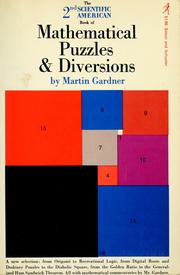
Martin Gardner’s “Mathematical Games” Department ran monthly in SCIENTIFIC AMERICAN. This second book is composed entirely of new games and puzzles that appeared there since Mr. Gardner’s first collection was published in 1959. Offering a new feast of mathematical entertainments to charm both layman and mathematician, some are easy, some are tough, and some call for scissors and paste. For most the only basic equipment needed is an alert and curious mind. All are connected, via the author’s clear and lively commentaries, to important aspects of mathematical thinking. Time will vanish as you turn Flexatubes inside out... play Piet Hein’s new game of Soma... consider the Mathematics of Cooling Coffee and Slicing Doughnuts... find your way through Hampton Court Maze (or any maze, in person or on paper)... explore, while folding a bird, the mathematics of Origami... divert yourself with Digital Roots... attack the maddening puzzle of the Monkey and the Coconuts. Play the new Induction Game of Eleusis - with a standard deck of cards - and you become a scientist outguessing the universe. Solve the new Smith-Jones-Robinson problems and you experience the triumphs of the logician. An easily learned parlor trick provides an introduction to the concept of Numerical Congruence. And the reader is shown how “humanity, bracing itself for the shock of finding life on other planets,” might draw comfort from the properties of Platonic Solids. In addition: brain teasers (18 of them, neat as epigrams); mind expanders (see the section on Ambiguity and Probability); Topological Magic with pencil, shoelace and soda straw; and a history-making report on the solution of a classic problem — squaring the square. The final chapter is surely the funniest commentary on numerology ever written. Add it all up - by mental arithmetic or with the help of the smartest of electronic calculators - and this is the total: topflight entertainment, delightful reading, and an invaluable key to the joys of…
Subjects: Mathematical recreations, Origami, Paper folding, Mathematical origami, Jeux mathématiques, Recreatieve wiskunde