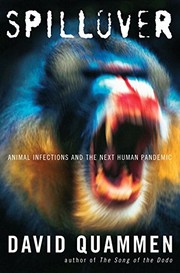
How long does it take to read Spillover?
Animal Infections and the Next Human Pandemic
David Quammen, Cécile Dutheil de La Rochère, Eva Roques, Laurence Decréau, Pascal Picq
Spillover by David Quammen, Cécile Dutheil de La Rochère, Eva Roques, Laurence Decréau, Pascal Picq takes about 10 hours 51 minutes to read at 250 words a minute.
About 10 hours 51 minutes
A week or two of reading
First published 2012. 592 pages, about 162,800 words.
22 days at 30 minutes a day
Estimate based on 275 words per page.
At other speeds
| Slow, 150 words a minute | 18 hours 5 minutes |
| Average, 250 words a minute | 10 hours 51 minutes |
| Fast, 400 words a minute | 6 hours 47 minutes |
The page count is the median across 11 editions, so your copy may differ. How we calculate.
About the book
This work examines the emergence and causes of new diseases all over the world, describing a process called "spillover" where illness originates in wild animals before being passed to humans and discusses the potential for the next huge pandemic. The emergence of strange new diseases is a frightening problem that seems to be getting worse. In this age of speedy travel, it threatens a worldwide pandemic. We hear news reports of Ebola, SARS, AIDS, and something called Hendra killing horses and people in Australia; but those reports miss the big truth that such phenomena are part of a single pattern. The bugs that transmit these diseases share one thing: they originate in wild animals and pass to humans by a process called spillover. As globalization spreads and as we destroy the ancient ecosystems, penetrating ever deeper into the furthest reaches of the planet, we encounter strange and dangerous infections that originate in animals but can be transmitted to humans. It is reckoned that at least 60% of our infections diseases derive from animals. Diseases that were contained are being set free and the results are potentially catastrophic. The author tracks this subject around the world. He recounts adventures in the field, netting bats in China, trapping monkeys in Bangladesh, stalking gorillas in the Congo, with the world's leading disease scientists. He takes the reader along on this quest to learn how, where from, and why these diseases emerge, and he asks the terrifying question: What might the next big one be?
Subjects: Animals as carriers of disease, Zoonoses, Epidemics, Communicable diseases in animals, Epidemics -- Forecasting, Communicable diseases -- Forecasting