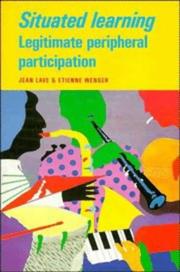
How long does it take to read Situated Learning?
Legitimate peripheral participation
Jean Lave
Situated Learning by Jean Lave takes about 2 hours 32 minutes to read at 250 words a minute.
About 2 hours 32 minutes
An evening's read
First published 1991. 138 pages, about 37,950 words.
6 days at 30 minutes a day
Estimate based on 275 words per page.
At other speeds
| Slow, 150 words a minute | 4 hours 13 minutes |
| Average, 250 words a minute | 2 hours 32 minutes |
| Fast, 400 words a minute | 1 hour 35 minutes |
The page count is the median across 3 editions, so your copy may differ. How we calculate.
About the book
In this volume, Lave and Wenger undertake a radical and important rethinking and reformulation of our conception of learning. By placing emphasis on the whole person, and by viewing agent, activity, and world as mutually constitutive, they give us the opportunity to escape from the tyranny of the assumption that learning is the reception of factual knowledge or information. The authors argue that most accounts of learning have ignored its quintessentially social character. To make the crucial step away from a solely epistemological account of the person, they propose that learning is a process of participation in communities of practice, participation that is at first legitimately peripheral but that increases gradually in engagement and complexity. Learning viewed as situated activity has as its central defining characteristic a process that we call legitimate peripheral participation. By this we mean to draw attention to the point that learners inevitably participate in communities of practitioners and that the mastery of knowledge and skill requires newcomers to move toward full participation in the sociocultural practice of a community. . . . A person's intentions to learn are engaged and the meaning of learning is configured through the process of becoming a full participant in a sociocultural practice. (PsycINFO Database Record (c) 2016 APA, all rights reserved)
Subjects: transfer of training, psychology of learning, community of practice, legitimate peripheral participation