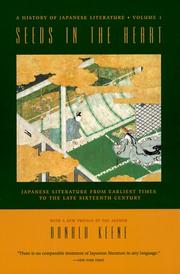
How long does it take to read Seeds in the Heart?
Japanese Literature from Earliest Times to the Late Sixteenth Century
Seeds in the Heart by Donald Keene takes about 23 hours 12 minutes to read at 250 words a minute.
About 23 hours 12 minutes
A long haul
First published 1993. 1,265 pages, about 347,875 words.
47 days (about 7 weeks) at 30 minutes a day
Estimate based on 275 words per page.
At other speeds
| Slow, 150 words a minute | 38 hours 39 minutes |
| Average, 250 words a minute | 23 hours 12 minutes |
| Fast, 400 words a minute | 14 hours 30 minutes |
The page count is the median across 3 editions, so your copy may differ. How we calculate.
About the book
With Seeds in the Heart, Donald Keene has completed his masterful, four-volume survey of Japanese literature from the earliest times to 1970--a major achievement of one of the world's most illustrious careers in literary criticism. Keene, the preeminent presenter of Japanese culture to the West, has long understood the key that literature holds to revealing a culture's sensibilities. This volume, like the first three, "will be hailed as definitive" (said Edwin O. Reischauer) as Keene employs his prodigious wealth of knowledge, depth of critical insight, and gift for narrative to guide us through one thousand years of a literary history that both defined the unique properties of Japanese prosody and prose, and produced some of its greatest works: the robust and grand poetry of the Manyoshu; the subtle and sparse perfection of the thirty-one syllable waka poem; The Tale of the Genji, still regarded as one of the greatest novels in world literature; the richly distilled poetic texts of the fifteenth-century No dramas; and the vast canvases of the medieval war tales, such as The Tale of the Heike. Detailed textual examinations of these and many other works at once present new scholarship to the expert and allow the lay reader to understand and enjoy Keene's narrative without prior knowledge of Japanese history. Above all, the author shows us the relevance this great body of literature has for all centuries; as the tenth-century poet Tsurayuki said, "Japanese poetry has its seeds in the human heart."
Subjects: History and criticism