How long does it take to read Science and Technology in World History?
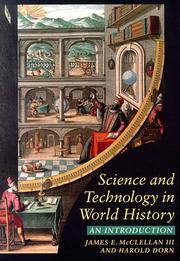
James E. McClellan III, domenico E. III bertoloni meli, Harold Dorn
Science and Technology in World History by James E. McClellan III, domenico E. III bertoloni meli, Harold Dorn takes about 8 hours 50 minutes to read at 250 words a minute.
About 8 hours 50 minutes
A week or two of reading
First published 1999. 482 pages, about 132,550 words.
18 days at 30 minutes a day
Estimate based on 275 words per page.
At other speeds
| Slow, 150 words a minute | 14 hours 44 minutes |
| Average, 250 words a minute | 8 hours 50 minutes |
| Fast, 400 words a minute | 5 hours 31 minutes |
The page count is the median across 10 editions, so your copy may differ. How we calculate.
About the book
In modern industrial society, the tie between science and technology seems clear, even inevitable. But historically, as James E. McClellan III and Harold Dorn remind us, the connection has been far less apparent. For much of human history, technology depended more on the innovation of skilled artisans than it did on the speculation of scientists. Technology as "applied science," the authors argue, emerged relatively recently, as industry and governments began funding scientific research that would lead directly to new or improved technologies. In Science and Technology in World History, McClellan and Dorn offer an introduction to this changing relationship. McClellan and Dorn review the historical record beginning with the thinking and tool making of prehistoric humans. Neolithic people, for example, developed metallurgy of a sort, using naturally occurring raw copper, and kept systematic records of the moon's phases. Neolithic craftsmen possessed practical knowledge of the behavior of clay, fire, and other elements of their environment, but though they may have had explanations for the phenomena of their crafts, they toiled without any systematic science of materials or the self-conscious application of theory to practice. McClellan and Dorn identify two great scientific traditions: the useful sciences, patronized by the state from the dawn of civilization, and scientific theorizing, initiated by the ancient Greeks. Theirs is a survey of the historical twists and turns of these traditions, leading to the science of our own day. Without neglecting important figures of Western science such as Newton and Einstein, the authors demonstrate the great achievements of non-Western cultures. They remind us that scientific traditions took root in China, India, and Central and South America, as well as in a series of Near Eastern empires, during late antiquity and the Middle Ages, including the vast region that formed the Islamic conquest. From this comparative perspective…
Subjects: History, Science, Technology, Tool and die makers, Natuurwetenschappen, Outilleurs