How long does it take to read Science and Hypothesis?
Henri Poincaré
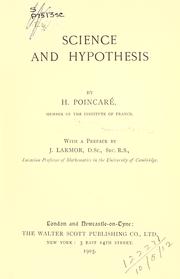
Science and Hypothesis by Henri Poincaré takes about 4 hours 28 minutes to read at 250 words a minute.
About 4 hours 28 minutes
A weekend read
First published 1900. 244 pages, about 67,100 words.
9 days at 30 minutes a day
Estimate based on 275 words per page.
At other speeds
| Slow, 150 words a minute | 7 hours 27 minutes |
| Average, 250 words a minute | 4 hours 28 minutes |
| Fast, 400 words a minute | 2 hours 48 minutes |
The page count is the median across 61 editions, so your copy may differ. How we calculate.
About the book
"Science and Hypothesis is a classic text in history and philosophy of science. Widely popular since its original publication in 1902, this first new translation of the work in over a century features unpublished material missing from earlier editions. Addressing errors introduced by Greenstreet and Halsted in their early 20th-century translations, it incorporates all the changes, corrections and additions Poincaré made over the years. Taking care to update the writing for a modern audience, Poincarés ideas and arguments on the role of hypotheses in mathematics and in science become clearer and closer to his original meaning, while David J. Stump's introduction gives fresh insights into Poincaré's philosophy of science. By approaching Science and Hypothesis from a contemporary perspective, it presents a better understanding of Poincare's hierarchy of the sciences, with arithmetic as the foundation, geometry as the science of space, then mechanics and the rest of physics. For philosophers of science and scientists working on problems of space, time and relativity, this is a much needed translation of a ground-breaking work which demonstrates why Poincaré is still relevant today. Poincaré saw the recognition of the role of hypotheses in science as an important alternative to both rationalism and empiricism. In Science and Hypothesis, his aim is to show that both in mathematics and in the physical sciences, scientists rely on hypotheses that are neither necessary first principles, as the rationalists claim, nor learned from experience, as the empiricist claim. These hypotheses fall into distinct classes, but he is most famous for his thesis of the conventionality of metric geometry. Poincaré discusses the sciences in a sequence, starting with arithmetic. Mathematical induction is essential in arithmetic, because only by using it can we make assertions about all numbers. Poincaré considers mathematical induction to be a genuine synthetic a priori judgment. He next…
Subjects: Mathematics, Philosophy, Science, Sciences, Mathématiques, Philosophie