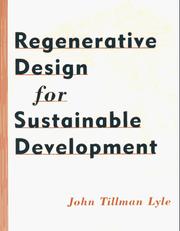
How long does it take to read Regenerative Design for Sustainable Development?
John Tillman Lyle
Regenerative Design for Sustainable Development by John Tillman Lyle takes about 6 hours 12 minutes to read at 250 words a minute.
About 6 hours 12 minutes
A weekend read
First published 1994. 338 pages, about 92,950 words.
13 days at 30 minutes a day
Estimate based on 275 words per page.
At other speeds
| Slow, 150 words a minute | 10 hours 20 minutes |
| Average, 250 words a minute | 6 hours 12 minutes |
| Fast, 400 words a minute | 3 hours 52 minutes |
The page count is the median across 4 editions, so your copy may differ. How we calculate.
About the book
Sustainable development is one of the most important topics in environmental design and the international environmental movement. From the 1992 Earth Summit in Rio de Janeiro to the 1993 AIA convention, sustainable development has been hailed as a way to reverse the downward environmental spiral produced by the industrial age. "Sustainable" describes systems that do not deplete their resources or damage their environment, but employ technology to integrate natural and man-made processes. And, as John Tillman Lyle clearly demonstrates in this groundbreaking volume, regenerative systems based on self-renewing processes whose end products are also their raw materials can be the building blocks of sustainable development. Regenerative Design for Sustainable Development is a practical guide to the theory, design, and construction of regenerative systems. Authored by one of the world's foremost authorities on environmental design, it describes practical applications to the essential systems of land development: energy flow, water flow, agriculture and land use, and building design. The book also explores the cultural, social, and economic implications of regenerative systems, and speculates on the global landscape that can result from their application. Many of the systems Lyle describes have been incorporated into the designs for the Center for Regenerative Studies - a 16-acre on-campus site at the California State Polytechnic University in Pomona designed to integrate regenerative systems of energy, water, shelter, food production, waste disposal, and other essential functions. . A central tenet of this book is that sustainable development relies on the interaction of numerous systems working in harmony with one another. To that end, Professor Lyle encourages collaborative, interdisciplinary team efforts that combine such seemingly diverse fields as solar design, water conservation, waste assimilation, and building construction. For landscape architects, civil…
Subjects: Environmental degradation, Environmental policy, Sustainable development, Nachhaltigkeit, Environnement, Développement durable