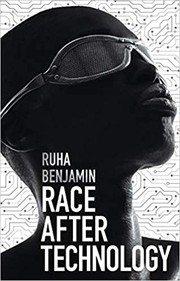
How long does it take to read Race After Technology?
Ruha Benjamin
Race After Technology by Ruha Benjamin takes about 3 hours 9 minutes to read at 250 words a minute.
About 3 hours 9 minutes
A weekend read
First published 2019. 172 pages, about 47,300 words.
7 days at 30 minutes a day
Estimate based on 275 words per page.
At other speeds
| Slow, 150 words a minute | 5 hours 15 minutes |
| Average, 250 words a minute | 3 hours 9 minutes |
| Fast, 400 words a minute | 1 hour 58 minutes |
The page count is the median across 3 editions, so your copy may differ. How we calculate.
About the book
"From everyday apps to complex algorithms, Ruha Benjamin cuts through tech-industry hype to understand how emerging technologies can reinforce white supremacy and deepen social inequity. Far from a sinister story of racist programmers scheming on the dark web, Benjamin argues that automation has the potential to hide, speed, and even deepen discrimination, while appearing neutral and even benevolent when compared to racism of a previous era. Presenting the concept of the New Jim Code, she shows how a range of discriminatory designs encode inequity: by explicitly amplifying racial hierarchies, by ignoring but thereby replicating social divisions, or by aiming to fix racial bias but ultimately doing quite the opposite. Moreover, she makes a compelling case for race itself as a kind of tool a technology designed to stratify and sanctify social injustice that is part of the architecture of everyday life. This illuminating guide into the world of biased bots, altruistic algorithms, and their many entanglements provides conceptual tools to decode tech promises with sociologically informed skepticism. In doing so, it challenges us to question not only the technologies we are sold, but also the ones we manufacture ourselves"-- "Cutting through tech-industry hype, this book explores how emerging technologies reinforce white supremacy. Conceptualizing the "New Jim Code," Benjamin shows how discriminatory designs can encode inequity and also makes a case for race itself as a kind of tool designed to stratify and sanctify social injustice"--
Subjects: Social history, Information technology, African americans, social conditions, Whites, United states, race relations, Digital divide