How long does it take to read Pattern Classification and Scene Analysis?
Pattern Classification and Scene Analysis by Richard O. Duda takes about 8 hours 50 minutes to read at 250 words a minute.
About 8 hours 50 minutes
A week or two of reading
First published 1973. 482 pages, about 132,550 words.
18 days at 30 minutes a day
Estimate based on 275 words per page.
At other speeds
| Slow, 150 words a minute | 14 hours 44 minutes |
| Average, 250 words a minute | 8 hours 50 minutes |
| Fast, 400 words a minute | 5 hours 31 minutes |
The page count is the median across 1 edition, so your copy may differ. How we calculate.
About the book
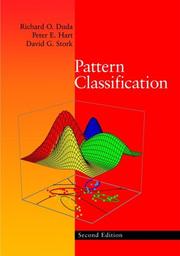
From the inside cover: Here is a unified, Comprehensive, and up–to–date treatment of the theoretical principles of pattern recognition. These principles are applicable to a great variety of problems of current interest, such as character recognition, speech recognition, speaker identification, fingerprint recognition, the analysis of biomedical photographs, aerial photoreconnaissance, automatic inspection for industrial quality control, and visual systems for robots. Throughout Pattern Classification and Scene Analysis, the authors have balanced their presentation to reflect the relative importance of the many theoretical topics in the field. Pattern Classification and Scene Analysis is the first book to provide comprehensive coverage of both statistical classification theory and computer analysis of pictures. Part I covers Bayesian decision theory, supervised and unsupervised learning, nonparametric techniques, discriminant analysis, and clustering. Part II describes many techniques of current interest in automatic scene analysis, including preprocessing of pictorial data, spatial filtering, shape–description techniques, perspective transformations, projective invariants, linguistic procedures, and artificial intelligence techniques for scene analysis. Although the theories and techniques of pattern recognition are largely mathematical, the authors have been more concerned with providing insight and understanding than with establishing rigorous mathematical foundations. The many illustrative examples, plausibility arguments, and discussions of the behavior of solutions reflect this concern. Extensive bibliographical and historical remarks at the end of each chapter further enhance the presentation. Standard notation is used wherever possible, and a comprehensive index is included. Typical first–year graduate students will find most of the mathematical arguments well within their grasp. Because the exposition is clear and balanced, Pattern Classification and Scene…
Subjects: statistics, pattern recognition, classification, machine learning, computer science, mathematics