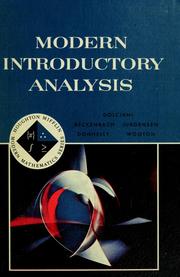
How long does it take to read Modern Introductory Analysis?
Mary P. Dolciani, Edwin F. Beckenback, Alfred J. Donnelly, Ray C. Jergensen, William Wooton, editorial adviser: Albert E. Meder, Jr.
Modern Introductory Analysis by Mary P. Dolciani, Edwin F. Beckenback, Alfred J. Donnelly, Ray C. Jergensen, William Wooton, editorial adviser: Albert E. Meder, Jr. takes about 11 hours 56 minutes to read at 250 words a minute.
About 11 hours 56 minutes
A week or two of reading
First published 1964. 651 pages, about 179,025 words.
24 days at 30 minutes a day
Estimate based on 275 words per page.
At other speeds
| Slow, 150 words a minute | 19 hours 54 minutes |
| Average, 250 words a minute | 11 hours 56 minutes |
| Fast, 400 words a minute | 7 hours 28 minutes |
The page count is the median across 6 editions, so your copy may differ. How we calculate.
About the book
As the title implies, this is an introductory text on mathematical analysis. It focuses on the logical basis of particular math topics which nowadays (as of 2012) are typically featured in a pre-calculus text. The 1967 teacher's edition is accessible to anyone who understands basic algebra. It is designed to prepare students to approach math in a methodical and rigorous manner from an elementary level. Some of the topics are outdated--it includes log and other tables. Although it is an elementary text, the approach used by the authors was meant to introduce logical rigor into high-school mathematics. The lessons are concerned with structure; some of the methods are quite out of favor now that electronic calculators are ubiquitous. This is the sort of math that a student ought to be able to appreciate without a calculator, i.e., it is more concerned with logical structure and proof (at least by the authors' standards) than with memorization of axioms without proof, backed by blind faith in calculators. At the time the text was first written there were no handheld calculators, so elegant algorithms were in demand. The text was designed to teach students how to construct algorithms based on mathematical reasoning. The one exception would be the inclusion of various log, trig, and other tables in the back that were probably computer generated, the algorithms for which were slightly beyond the scope of the text.
Subjects: Mathematical analysis, Mathematics, Analyse mathématique