How long does it take to read Lost Person Behavior?
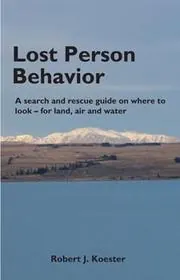
a search and rescue guide on where to look for land, air, and water
Robert J. Koester
Lost Person Behavior by Robert J. Koester takes about 7 hours 38 minutes to read at 250 words a minute.
About 7 hours 38 minutes
A weekend read
First published 2008. 416 pages, about 114,400 words.
16 days at 30 minutes a day
Estimate based on 275 words per page.
At other speeds
| Slow, 150 words a minute | 12 hours 43 minutes |
| Average, 250 words a minute | 7 hours 38 minutes |
| Fast, 400 words a minute | 4 hours 46 minutes |
The page count is the median across 1 edition, so your copy may differ. How we calculate.
About the book
Lost person behavior is the cornerstone of search and rescue efforts. Based upon a landmark study, this book is the definitive guide to solving the puzzle of where a lost person might be found. Nowhere else is it possible to learn about the latest subject categories, behavioral profiles, up to date statistics, suggested initial tasks, and specialized investigative questions. Whether the subject is underground, underwater, under collapsed rubble, on land or has fallen from the sky, this book delivers what search managers need. Lost Person Behavior provides the reader with: an indispensable book that can be used as a field reference (special rugged binding allows the book to lay flat) and an essential library reference; the latest search and rescue incident statistics from the International Search & Rescue Incident Database (ISRID), which contains over 50,000 SAR incidents; 41 subject categories, many of which are new and presented for the first time; new detailed behavioral profiles that give insight into what drives the basic behaviors of lost people; statistics based upon ecoregions to best match your specific search areas; new types of statistical information; find location, scenario analysis, mobility time, survivability, elevation changes, track offset, dispersion angles, plus classic statistics such as distance from the initial planning point; |view example section| the ability to pinpoint the most likely areas to search, then determine initial tasks quickly using reflex tasking, the bike wheel model, and quick consensus. The purpose of this book is simple: To help searchers look in the right place to find lost subjects faster.
Subjects: Missing persons, Investigation, Psychology, Databases