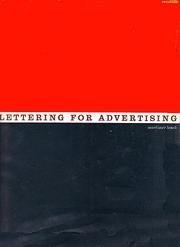
How long does it take to read Lettering for Advertising?
Mortimer Leach
Lettering for Advertising by Mortimer Leach takes about 4 hours 11 minutes to read at 250 words a minute.
About 4 hours 11 minutes
A weekend read
First published 1956. 228 pages, about 62,700 words.
9 days at 30 minutes a day
Estimate based on 275 words per page.
At other speeds
| Slow, 150 words a minute | 6 hours 58 minutes |
| Average, 250 words a minute | 4 hours 11 minutes |
| Fast, 400 words a minute | 2 hours 37 minutes |
The page count is the median across 6 editions, so your copy may differ. How we calculate.
About the book
This book should prove to be as valuable to beginners, advanced students, and professionals in the field of graphic arts in general, as to the lettering specialist. In it the author analyzes thoroughly individual letter construction, including alphabets which have influenced the design of most contemporary forms, and comparisons of type and hand lettering. Lettering for Advertising uses as examples of various letter forms, Caslon, Gothic, Bodoni, Brush Scripts and Brush Letters, and Formal Scripts. In addition, the book includes a complete chapter on how to indicate lettering for layouts, with many professional examples, which will be particularly helpful to students of lettering and to graphic artists in other fields who need to indicate lettering only occasionally. The book contains a how-not-to-do-it page after each alphabet chapter; this explains the most common errors found in beginners' work. These pages offer a basis for student self-criticism after a practice caption has been lettered. Each chapter ends with an Art Director's pencil indication, done in the style covered in that chapter; this gives the reader an opportunity to use the professional approach of drawing a finished caption by making an original trace-off from this indication, holding to the specifications of weight, proportion, and area. For those students who intend to specialize in lettering, the book covers the basic data necessary before sophisticated expressions of lettering can be attempted. Those students who aspire to become art directors will find the book valuable, too, because it shows how to indicate captions clearly on layouts, and how to buy finished lettering with discrimination. The professional letterer will be able to use the book as a ready refresher reference, and the professional graphic artist who does not specialize in lettering will find the book indispensable.
Subjects: Graphic design, Lettering, Technique, Graphic arts