How long does it take to read Latviešu Etimoloģijas Vārdnīca?
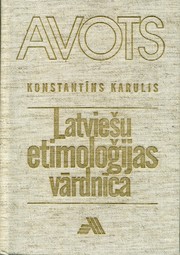
Konstantīns Karulis
Latviešu Etimoloģijas Vārdnīca by Konstantīns Karulis takes about 23 hours 54 minutes to read at 250 words a minute.
About 23 hours 54 minutes
A long haul
First published 1992. 1,304 pages, about 358,600 words.
48 days (about 7 weeks) at 30 minutes a day
Estimate based on 275 words per page.
At other speeds
| Slow, 150 words a minute | 39 hours 51 minutes |
| Average, 250 words a minute | 23 hours 54 minutes |
| Fast, 400 words a minute | 14 hours 57 minutes |
The page count is the median across 1 edition, so your copy may differ. How we calculate.
About the book
Latvian etymology is a relatively new study of a rather old Indo-European language. Latvia's population in 2011 was said to be 2.2 million. Most Latvian speakers live in Latvia, making Latvian etymology a seemingly narrow study. Latvia, caught between much larger Slavic and Germanic states, has meant Latvia has been subordinated to ruling groups who either had no interest in the Latvian language, or who went so far as to try to suppress it. Thus, the formal study of Latvian etymology is comparatively recent, paralleling the emergence of Latvian self-identification, sometimes called the tautas atmoda, and an interest in things Latvian. Nothing like the complete Oxford English Dictionary exists for students, scholars, and individuals who seek to better understand the roots of the modern Latvian language. However, Konstantins Karulis', "Latviesu Etimologijas Vardnica," is an excellent resource. It is written in the Latvian language, in its 1,300 pages, the author traces a great many, although by no means all, the words in the Latvian language. For those of us who have a native facility with the Latvian language, it helps in a deeper appreciation of the origins. At the same time, this reviewer believes that the succinct presentation by the book's author can make the book somewhat accessible to the reader who has a dictionary translating his/her native language into Latvian, and who then can "bridge" to the information contained within, at least at the basic definition and root level. This is because the entries are well laid out, which make them easy to follow. The author cites his sources and additional references, for those wishing to look further into the assumptions of the author. Though Latvian, like its "cousin," Lithuanian, may be a spoken by a smaller number of people, this book provides another avenue of insight into the proto-Indo-European languages, and Karulis' work is worth review by those who are interested in this subject.
Subjects: Etymology, Dictionaries, IDE