How long does it take to read IBM and the Holocaust?
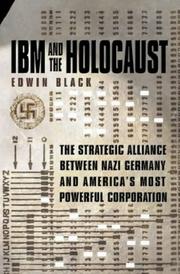
The Strategic Alliance Between Nazi Germany and America's Most Powerful Corporation
IBM and the Holocaust by Edwin Black takes about 10 hours 16 minutes to read at 250 words a minute.
About 10 hours 16 minutes
A week or two of reading
First published 2001. 560 pages, about 154,000 words.
21 days at 30 minutes a day
Estimate based on 275 words per page.
At other speeds
| Slow, 150 words a minute | 17 hours 7 minutes |
| Average, 250 words a minute | 10 hours 16 minutes |
| Fast, 400 words a minute | 6 hours 25 minutes |
The page count is the median across 19 editions, so your copy may differ. How we calculate.
About the book
IBM and the Holocaust is the stunning story of IBM's strategic alliance with Nazi Germany -- beginning in 1933 in the first weeks that Hitler came to power and continuing throughout World War II. As the Third Reich embarked upon its plan of conquest and genocide, IBM and its subsidiaries helped create enabling technologies, step-by-step, from the identification and cataloging programs of the 1930s to the selections of the 1940s. Only after Jews were identified -- a massive and complex task that Hitler wanted done immediately -- could they be targeted for efficient asset confiscation, ghettoization, deportation, enslaved labor, and, ultimately, annihilation. It was a cross-tabulation and organizational challenge so monumental, it called for a computer. Of course, in the 1930s no computer existed. But IBM's Hollerith punch card technology did exist. Aided by the company's custom-designed and constantly updated Hollerith systems, Hitler was able to automate his persecution of the Jews. Historians have always been amazed at the speed and accuracy with which the Nazis were able to identify and locate European Jewry. Until now, the pieces of this puzzle have never been fully assembled. The fact is, IBM technology was used to organize nearly everything in Germany and then Nazi Europe, from the identification of the Jews in censuses, registrations, and ancestral tracing programs to the running of railroads and organizing of concentration camp slave labor. IBM and its German subsidiary custom-designed complex solutions, one by one, anticipating the Reich's needs. They did not merely sell the machines and walk away. Instead, IBM leased these machines for high fees and became the sole source of the billions of punch cards Hitler needed. IBM and the Holocaust takes you through the carefully crafted corporate collusion with the Third Reich, as well as the structured deniability of oral agreements, undated letters, and the Geneva intermediaries -- all undertaken as the…
Subjects: Statistical services, Jews, Data processing, History, Jews, germany, United states, commerce, germany