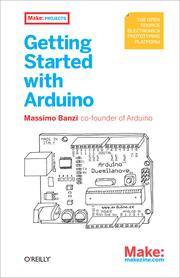
How long does it take to read Getting Started with Arduino?
Massimo Banzi
Getting Started with Arduino by Massimo Banzi takes about 2 hours 10 minutes to read at 250 words a minute.
About 2 hours 10 minutes
An evening's read
First published 2008. 118 pages, about 32,450 words.
5 days at 30 minutes a day
Estimate based on 275 words per page.
At other speeds
| Slow, 150 words a minute | 3 hours 36 minutes |
| Average, 250 words a minute | 2 hours 10 minutes |
| Fast, 400 words a minute | 1 hour 21 minutes |
The page count is the median across 2 editions, so your copy may differ. How we calculate.
About the book
The Arduino Hardware The Arduino board is a small microcontroller board, which is a small circuit (the board) that contains a whole computer on a small chip (the microcontroller). This computer is at least a thousand times less powerful than the MacBook I’m using to write this, but it’s a lot cheaper and very useful to build interesting devices. Look at the Arduino board: you’ll see a black chip with 28 “legs”—that chip is the ATmega168, the heart of your board. We (the Arduino team) have placed on this board all the components that are required for this microcontroller to work properly and to communicate with your computer. There are many versions of this board; the one we’ll use throughout this book is the Arduino Duemilanove, which is the simplest one to use and the best one for learning on. However, these instructions apply to earlier versions of the board, including the more recent Arduino Diecimila and the older Arduino NG. The figure on the left below shows the Arduino Duemilanove; The figure on the right shows the Arduino NG. Product Description This valuable little book offers a thorough introduction to the open-source electronics prototyping platform that's taking the design and hobbyist world by storm. Getting Started with Arduino gives you lots of ideas for Arduino projects and helps you get going on them right away. From getting organized to putting the final touches on your prototype, all the information you need is right in the book. Inside, you'll learn about: * Interaction design and physical computing * The Arduino hardware and software development environment * Basics of electricity and electronics * Prototyping on a solderless breadboard * Drawing a schematic diagram And more. With inexpensive hardware and open-source software components that you can download free, getting started with Arduino is a snap. To use the introductory examples in this book, all you need is a USB Arduino, USB A-B cable, and an LED. Join the tens of thousands of…
Subjects: Development, Interactive multimedia, Open source software, Arduino, Handbooks, manuals, Arduino (Computer langauge)