How long does it take to read Excel VBA Programming For Dummies?
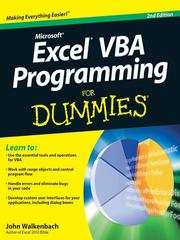
Excel VBA Programming For Dummies by John Walkenbach takes about 7 hours 29 minutes to read at 250 words a minute.
About 7 hours 29 minutes
A weekend read
First published 2004. 408 pages, about 112,200 words.
15 days at 30 minutes a day
Estimate based on 275 words per page.
At other speeds
| Slow, 150 words a minute | 12 hours 28 minutes |
| Average, 250 words a minute | 7 hours 29 minutes |
| Fast, 400 words a minute | 4 hours 41 minutes |
The page count is the median across 15 editions, so your copy may differ. How we calculate.
About the book
Having Excel and just using it for standard spreadsheets is a little like getting the ultimate cable system and a 50" flat panel plasma HDTV and using it exclusively to watch Lawrence Welk reruns. With Visual Basic for Applications (VBA) programming, you can take advantage of numerous Excel options such as: creating new worksheet functions; automating tasks and operations; creating new appearances, toolbars, and menus; designing custom dialog boxes and add-ins; and much more. This guide is not for rank Excel amateurs. It's for intermediate to advanced Excel users who want to learn VBA programming (or whose bosses want them to learn VBA programming). You need to know your way around Excel before you start creating customized short cuts or systems for speeding through Excel functions. If you're an intermediate or advanced Excel user, Excel VBA For Dummies helps you take your skills (and your spreadsheets) to the next level. It includes: An introduction to the VBA language A hands-on, guided, step-by-step walk through developing a useful VBA macro, including recording, testing, and changing it, and testing it The essential foundation, including the Visual Basic Editor (VBE) and its components, modules, Excel object model, subroutines and functions, and the Excel macro recorder The essential VBA language elements, including comments, variables and constants, and labels Working with Range objects and discovering useful Range objective properties and methods Using VBA and worksheet functions, including a list and examples Programming constructions, including the GoTo statement, the If-Then structure, Select Case, For-Next loop, Do-While loop, and Do-Until loop Automatic procedures and Workbook events, including a table and event-handler procedures Error-handling and bug extermination techniques, and using the Excel debugging tools Creating custom dialog boxes, also known as UserForms, with a table of the toolbox controls and their capabilities, how-to for the dialog box…
Subjects: Computer Technology, Nonfiction, Business, computer programs, Electronic spreadsheets, Microsoft excel (computer program), Microsoft Excel (Computer file)