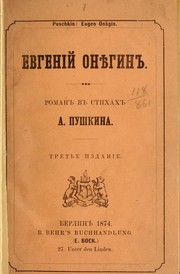
How long does it take to read Eugene Onegin?
Eugene Onegin by Alexander Pushkin takes about 4 hours 27 minutes to read at 250 words a minute.
About 4 hours 27 minutes
A weekend read
First published 1833. 243 pages, about 66,825 words.
9 days at 30 minutes a day
Estimate based on 275 words per page.
At other speeds
| Slow, 150 words a minute | 7 hours 26 minutes |
| Average, 250 words a minute | 4 hours 27 minutes |
| Fast, 400 words a minute | 2 hours 47 minutes |
The page count is the median across 102 editions, so your copy may differ. How we calculate.
About the book
Eugene Onegin (Russian: Евге́ний Оне́гин, BGN/PCGN: Yevgeniy Onegin) is a novel in verse written by Alexander Pushkin. It is a classic of Russian literature, and its eponymous protagonist has served as the model for a number of Russian literary heroes (so-called superfluous men). It was published in serial form between 1825 and 1832. The first complete edition was published in 1833, and the currently accepted version is based on the 1837 publication. Almost the entire work is made up of 389 stanzas of iambic tetrameter with the unusual rhyme scheme "AbAbCCddEffEgg", where the uppercase letters represent feminine rhymes while the lowercase letters represent masculine rhymes. This form has come to be known as the "Onegin stanza" or the "Pushkin sonnet." The rhythm, innovative rhyme scheme, the natural tone and diction, and the economical transparency of presentation all demonstrate the virtuosity which has been instrumental in proclaiming Pushkin as the undisputed master of Russian poetry. The story is told by a narrator (a lightly fictionalized version of Pushkin's public image), whose tone is educated, worldly, and intimate. The narrator digresses at times, usually to expand on aspects of this social and intellectual world. This allows for a development of the characters and emphasises the drama of the plot despite its relative simplicity. The book is admired for the artfulness of its verse narrative as well as for its exploration of life, death, love, ennui, convention and passion. It influenced Vikram Seth's Golden Gate.
Subjects: Social life and customs, Man-woman relationships, Russian fiction, Poetry, Fiction, Russian poetry