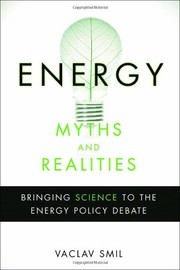
How long does it take to read Energy Myths and Realities?
Energy Myths and Realities by Vaclav Smil takes about 4 hours 13 minutes to read at 250 words a minute.
About 4 hours 13 minutes
A weekend read
First published 2010. 230 pages, about 63,250 words.
9 days at 30 minutes a day
Estimate based on 275 words per page.
At other speeds
| Slow, 150 words a minute | 7 hours 2 minutes |
| Average, 250 words a minute | 4 hours 13 minutes |
| Fast, 400 words a minute | 2 hours 38 minutes |
The page count is the median across 3 editions, so your copy may differ. How we calculate.
About the book
MYTH: New energy sources and technical innovations will eliminate the need for fossil fuels within a few decades. REALITY: Comprehensive energy transitions take several generations. MYTH: Carbon sequestration (that is, capturing CO2 emissions from the atmosphere and storing it) is the solution to global climate change. REALITY: Because of its costs, technical challenges, and problems with social acceptance, carbon sequestration will not be able to prevent further substantial rise in carbon emissions. MYTH: Electric cars will replace conventional cars in the near future. REALITY: Electric cars are expensive, their adoption rate will be slow, and internal combustion engines will dominate the market for decades to come. These are just a few of the misconceptions about the future of global energy often presented as facts in everyday political discourse, explains energy scientist Vaclav Smil. In his just-published Energy Myths and Realities: Bringing Science to the Energy Policy Debate (AEI Press, 2010), Smil warns that while the propagation of these incorrect facts appears harmless, it is in fact hampering the development of effective new energy policies and wasting time and money which could be better used in pursuit of a constructive, scientific approach to the global energy challenge. Among the many popular misconceptions about energy that Smil deconstructs: The world will soon run out of oil. Although the share of conventional oil in the global energy supply will gradually decrease, liquid hydrocarbons will remain a major source of energy for decades to come. Large-scale nuclear energy adoption will solve our energy challenge. No rational long-range energy plan should exclude the nuclear option, but past experience with commercial nuclear generation dictates a great deal of caution: We must take into account irrational risk perceptions, dangers of nuclear proliferation, and the need for selection and maintenance of permanent disposal sites for radioactive wastes…
Subjects: Renewable energy sources, Energy policy