How long does it take to read Don't Get Too Comfortable?
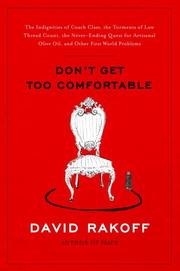
The Indignities of Coach Class, The Torments of Low Thread Count, The Never- Ending Quest for Artisanal Olive Oil, and Other First World Problems
David Rakoff
Don't Get Too Comfortable by David Rakoff takes about 4 hours 4 minutes to read at 250 words a minute.
About 4 hours 4 minutes
A weekend read
First published 2005. 222 pages, about 61,050 words.
9 days at 30 minutes a day
Estimate based on 275 words per page.
At other speeds
| Slow, 150 words a minute | 6 hours 47 minutes |
| Average, 250 words a minute | 4 hours 4 minutes |
| Fast, 400 words a minute | 2 hours 33 minutes |
The page count is the median across 7 editions, so your copy may differ. How we calculate.
About the book
David Rakoff’s bestselling collection of autobiographical essays, Fraud, established him as one of today’s funniest and most insightful writers. Now, in Don’t Get Too Comfortable, Rakoff moves from the personal to the public, journeying into the land of unchecked plenty that is contemporary America. Rarely have greed, vanity, selfishness, and vapidity been so mercilessly and wittily skewered. Somewhere along the line, our healthy self-regard has exploded into obliterating narcissism; our manic getting and spending have now become celebrated as moral virtues. Whether contrasting the elegance of one of the last flights of the supersonic Concorde with the good-times-and-chicken-wings populism of Hooters Air, working as a cabana boy at a South Beach hotel, or traveling to a private island off the coast of Belize to watch a soft-core video shoot—where he is provided with his very own personal manservant—Rakoff takes us on a bitingly funny grand tour of our culture of excess. He comes away from his explorations hilariously horrified. At once a Wildean satire of our ridiculous culture of overconsumption and a plea for a little human decency, Don’t Get Too Comfortable shows that far from being bobos in paradise, we’re in a special circle of gilded-age hell.
Subjects: Consumption (Economics), Consumer behavior, Social status, Social life and customs, Humor, American essays