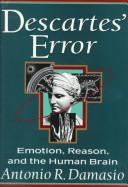
How long does it take to read Descartes' Error?
Antonio R. Damasio, Antonio R. Damasio MD PhD
Descartes' Error by Antonio R. Damasio, Antonio R. Damasio MD PhD takes about 5 hours 43 minutes to read at 250 words a minute.
About 5 hours 43 minutes
A weekend read
First published 1994. 312 pages, about 85,800 words.
12 days at 30 minutes a day
Estimate based on 275 words per page.
At other speeds
| Slow, 150 words a minute | 9 hours 32 minutes |
| Average, 250 words a minute | 5 hours 43 minutes |
| Fast, 400 words a minute | 3 hours 35 minutes |
The page count is the median across 8 editions, so your copy may differ. How we calculate.
About the book
""Although I cannot tell for certain what sparked my interest in the neural underpinnings of reason, I do know when I became convinced that the traditional views on the nature of rationality could not be correct." Thus begins a book that takes the reader on a journey of discovery, from the story of Phineas Gage, the famous nineteenth-century case of behavioral change that followed brain damage, to the contemporary recreation of Gage's brain; and from the doubts of a young neurologist to a testable hypothesis concerning the emotions and their fundamental role in rational human behavior." "Drawing on his experiences with neurological patients affected by brain damage (his laboratory is recognized worldwide as the foremost center for the study of such patients), Antonio Damasio shows how the absence of emotion and feeling can break down rationality. In the course of explaining how emotions and feelings contribute to reason and to adaptive social behavior, Damasio also offers a novel perspective on what emotions and feelings actually are: a direct sensing of our own body states, a link between the body and its survival-oriented regulations, on the one hand, and consciousness, on the other." "Descartes' Error leads us to conclude that human organisms are endowed from the very beginning with a spirited passion for making choices, which the social mind can use to build rational behavior."--Jacket.
Subjects: Emotions, Neuropsychology, Physiological aspects, Physiological aspects of Emotions, Physiological aspects of Reason, Physiology