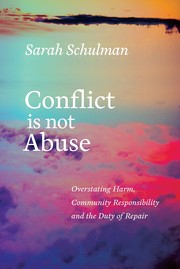
How long does it take to read Conflict Is Not Abuse?
Conflict Is Not Abuse by Sarah Schulman takes about 5 hours 23 minutes to read at 250 words a minute.
About 5 hours 23 minutes
A weekend read
First published 2016. 294 pages, about 80,850 words.
11 days at 30 minutes a day
Estimate based on 275 words per page.
At other speeds
| Slow, 150 words a minute | 8 hours 59 minutes |
| Average, 250 words a minute | 5 hours 23 minutes |
| Fast, 400 words a minute | 3 hours 22 minutes |
The page count is the median across 2 editions, so your copy may differ. How we calculate.
About the book
From intimate relationships to global politics, Sarah Schulman observes a continuum: that inflated accusations of harm are used to avoid accountability. Illuminating the difference between Conflict and Abuse, Schulman directly addresses our contemporary culture of scapegoating. This deep, brave, and bold work reveals how punishment replaces personal and collective self-criticism, and shows why difference is so often used to justify cruelty and shunning. Rooting the problem of escalation in negative group relationships, Schulman illuminates the ways cliques, communities, families, and religious, racial, and national groups bond through the refusal to change their self-concept. She illustrates how Supremacy behavior and Traumatized behavior resemble each other, through a shared inability to tolerate difference. This important and sure to be controversial book illuminates such contemporary and historical issues of personal, racial, and geo-political difference as tools of escalation towards injustice, exclusion, and punishment, whether the objects of dehumanization are other individuals in our families or communities, people with HIV, African Americans, or Palestinians. Conflict Is Not Abuse is a searing rejection of the cultural phenomenon of blame, cruelty, and scapegoating, and how those in positions of power exacerbate and manipulate fear of the "other" to achieve their goals.
Subjects: Difference (Psychology), Social psychology, Conflict management, Social conflict, LGBTQ anthropology