How long does it take to read Computer Networks?
Andrew S. Tanenbaum, John David Wetherall, David J. Wetherall, Nickolas Feamster, David Wetherall, James F. Kurose, Keith W. Ross
Computer Networks by Andrew S. Tanenbaum, John David Wetherall, David J. Wetherall, Nickolas Feamster, David Wetherall, James F. Kurose, Keith W. Ross takes about 14 hours 54 minutes to read at 250 words a minute.
About 14 hours 54 minutes
A week or two of reading
First published 1981. 813 pages, about 223,575 words.
30 days at 30 minutes a day
Estimate based on 275 words per page.
At other speeds
| Slow, 150 words a minute | 24 hours 51 minutes |
| Average, 250 words a minute | 14 hours 54 minutes |
| Fast, 400 words a minute | 9 hours 19 minutes |
The page count is the median across 42 editions, so your copy may differ. How we calculate.
About the book
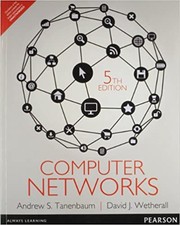
A contemporary, yet classic, introduction to today's key networking technologies Computer Networks, Fifth Edition, is the ideal introduction to the networking field. This bestseller reflects the latest networking technologies with a special emphasis on wireless networking, including 802.11, 802.16, Bluetooth™, and 3G cellular, paired with fixed-network coverage of ADSL, Internet over cable, gigabit Ethernet, MLPS, and peer-to-peer networks. Notably, this latest edition incorporates new coverage on 3G mobile phone networks, Fiber to the Home, RIFD, delay-tolerant networks, and 802.11 security, in addition to expanded material on Internet routing, multicasting, congestion control, quality of service, real-time transport, and content distribution. Authors Andrew Tanenbaum and Davis Wetherall describe the inner facets of the network, exploring its functionality from underlying hardware to applications, including: Physical layer (e.g., copper, fiber, wireless, satellites, and Internet over cable) Data link layer (e.g., protocol principles, protocol verification, HDLC, and PPP) MAC Sublayer (e.g., gigabit Ethernet, 802.11, broadband wireless, and switching) Network layer (e.g., routing algorithms, congestion control, QoS, IPv4, and IPv6) Transport layer (e.g., socket programming, UDP, TCP, RTP, and network performance) Application layer (e.g., e-mail, the Web, PHP, wireless Web, MP3, and streaming audio) Network security (e.g., AES, RSA, quantum cryptography, IPsec, and Web security) The book dissects and depicts the principles associated with each layer and then translates them through examples from the Internet and wireless networks.
Subjects: Computer networks, Ordinateurs réseaux d', Réseaux d'ordinateurs, Computernetwerken, Rechnernetz, Television journalists