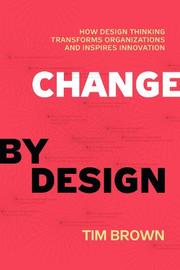
How long does it take to read Change by Design?
Tim Brown
Change by Design by Tim Brown takes about 4 hours 50 minutes to read at 250 words a minute.
About 4 hours 50 minutes
A weekend read
First published 2009. 264 pages, about 72,600 words.
10 days at 30 minutes a day
Estimate based on 275 words per page.
At other speeds
| Slow, 150 words a minute | 8 hours 4 minutes |
| Average, 250 words a minute | 4 hours 50 minutes |
| Fast, 400 words a minute | 3 hours 2 minutes |
The page count is the median across 2 editions, so your copy may differ. How we calculate.
About the book
The myth of innovation is that brilliant ideas leap fully formed from the minds of geniuses. In reality, most innovations are borne from rigor and discipline. Breakthrough ideas-whether for a new bicycle, an advertising campaign, a treatment plan for diabetes, or a program aimed at tackling the national obesity epidemic-emerge not by chance, but by studying and embracing the immediate challenges we encounter every day in our offices and homes, laboratories and hospitals, classrooms and conference rooms, and in all the spaces in between. We don't simply realize solutions; we design them. In this book Tim Brown, CEO of the celebrated innovation and design firm IDEO, introduces us to design thinking. Design is not just about creating elegant objects or beautifying the world around us. The best designers match necessity to utility, constraint to possibility, and need to demand. These design thinkers rely on rigorous observations of how we use spaces and the objects and services that occupy them; they discover patterns where others see complexity and confusion; they synthesize new ideas from seemingly disparate fragments; and they convert problems into opportunities. Design thinking is a method in which genius, in the end, is not required. Design thinking is valuable not just in so-called creative industries or for people tasked with designing products. Rather, it is often most powerful when applied to abstract, multifaceted problems: improving a guest experience at a hotel, encouraging bank customers to save more, or developing a compelling narrative for a public-service campaign. It has been used by organizations such as Nokia to rethink global gaming and by the Department of Energy to encourage conservation. Design thinking is now being applied to address a wide range of issues and concerns, from the delivery of clean drinking water in the developing world to improving the efficacy of airport security and microfinancing. This is not a book by designers for designers…
Subjects: Business, Nonfiction, Industrial design, Organizational change, Reengineering (Management), Corporate reorganizations