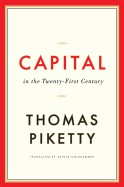
How long does it take to read Capital in the Twenty-First Century?
Capital in the Twenty-First Century by Thomas Piketty takes about 14 hours 58 minutes to read at 250 words a minute.
About 14 hours 58 minutes
A week or two of reading
First published 2013. 816 pages, about 224,400 words.
30 days at 30 minutes a day
Estimate based on 275 words per page.
At other speeds
| Slow, 150 words a minute | 24 hours 56 minutes |
| Average, 250 words a minute | 14 hours 58 minutes |
| Fast, 400 words a minute | 9 hours 21 minutes |
The page count is the median across 20 editions, so your copy may differ. How we calculate.
About the book
What are the grand dynamics that drive the accumulation and distribution of capital? Questions about the long-term evolution of inequality, the concentration of wealth, and the prospects for economic growth lie at the heart of political economy. But satisfactory answers have been hard to find for lack of adequate data and clear guiding theories. In Capital in the Twenty-First Century, Thomas Piketty analyzes a unique collection of data from twenty countries, ranging as far back as the eighteenth century, to uncover key economic and social patterns. His findings will transform debate and set the agenda for the next generation of thought about wealth and inequality. Piketty shows that modern economic growth and the diffusion of knowledge have allowed us to avoid inequalities on the apocalyptic scale predicted by Karl Marx. But we have not modified the deep structures of capital and inequality as much as we thought in the optimistic decades following World War II. The main driver of inequality--the tendency of returns on capital to exceed the rate of economic growth--today threatens to generate extreme inequalities that stir discontent and undermine democratic values. But economic trends are not acts of God. Political action has curbed dangerous inequalities in the past, Piketty says, and may do so again. A work of extraordinary ambition, originality, and rigor, Capital in the Twenty-First Century reorients our understanding of economic history and confronts us with sobering lessons for today. (Original text from the spine of the book)
Subjects: Capitalism, wealth, capital, inequality, social welfare, democracy