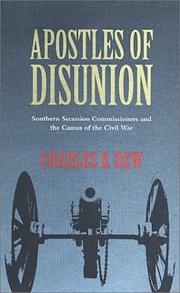
How long does it take to read Apostles of Disunion?
Charles B. Dew
Apostles of Disunion by Charles B. Dew takes about 2 hours 52 minutes to read at 250 words a minute.
About 2 hours 52 minutes
An evening's read
First published 2001. 156 pages, about 42,900 words.
6 days at 30 minutes a day
Estimate based on 275 words per page.
At other speeds
| Slow, 150 words a minute | 4 hours 46 minutes |
| Average, 250 words a minute | 2 hours 52 minutes |
| Fast, 400 words a minute | 1 hour 47 minutes |
The page count is the median across 5 editions, so your copy may differ. How we calculate.
About the book
"In late 1860 and early 1861, state-appointed commissioners traveled the length and breadth of the slave South carrying a fervent message in pursuit of a clear goal: to persuade the political leadership and the citizenry of the uncommitted slave states to join in the effort to destroy the Union and forge a new Southern nation.". "Directly refuting the neo-Confederate contention that slavery was neither the reason for secession nor the catalyst for the resulting onset of hostilities in 1861, Charles B. Dew finds in the commissioners' brutally candid rhetoric a stark white supremacist ideology that proves the contrary. The commissioners included in their speeches a constitutional justification for secession, to be sure, and they pointed to a number of political "outrages" committed by the North in the decades prior to Lincoln's election. But the core of their argument - the reason the right of secession had to be invoked and invoked immediately - did not turn on matters of constitutional interpretation or political principle. Over and over again, the commissioners returned to the same point: that Lincoln's election signaled an unequivocal commitment on the part of the North to destroy slavery and that emancipation would plunge the South into a racial nightmare.". "Dew's discovery and study of the highly illuminating public letters and speeches of these apostles of disunion - often relatively obscure men sent out to convert the unconverted to the secessionist cause - have led him to suggest that the arguments the commissioners presented provide us with the best evidence we have of the motives behind the secession of the lower South in 1860-61."--BOOK JACKET.
Subjects: Politics and government, Race relations, Slavery, Political aspects of Slavery, Secession, Political aspects