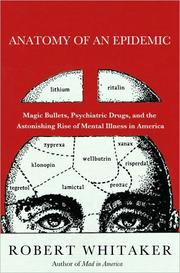
How long does it take to read Anatomy of an Epidemic?
Magic Bullets, Psychiatric Drugs, and the Astonishing Rise of Mental Illness in America
Robert Whitaker
Anatomy of an Epidemic by Robert Whitaker takes about 7 hours 24 minutes to read at 250 words a minute.
About 7 hours 24 minutes
A weekend read
First published 2010. 404 pages, about 111,100 words.
15 days at 30 minutes a day
Estimate based on 275 words per page.
At other speeds
| Slow, 150 words a minute | 12 hours 21 minutes |
| Average, 250 words a minute | 7 hours 24 minutes |
| Fast, 400 words a minute | 4 hours 38 minutes |
The page count is the median across 4 editions, so your copy may differ. How we calculate.
About the book
In this astonishing and startling book, award-winning science and history writer Robert Whitaker investigates a medical mystery: Why has the number of disabled mentally ill in the United States tripled over the past two decades? Every day, 1,100 adults and children are added to the government disability rolls because they have become newly disabled by mental illness, with this epidemic spreading most rapidly among our nation's children. What is going on? Anatomy of an Epidemic challenges readers to think through that question themselves. First, Whitaker investigates what is known today about the biological causes of mental disorders. Do psychiatric medications fix "chemical imbalances" in the brain, or do they, in fact, create them? Researchers spent decades studying that question, and by the late 1980s, they had their answer. Readers will be startledand dismayedto discover what was reported in the scientific journals. Then comes the scientific query at the heart of this book: During the past fifty years, when investigators looked at how psychiatric drugs affected long-term outcomes, what did they find? Did they discover that the drugs help people stay well? Function better? Enjoy good physical health? Or did they find that these medications, for some paradoxical reason, increase the likelihood that people will become chronically ill, less able to function well, more prone to physical illness? This is the first book to look at the merits of psychiatric medications through the prism of long-term results. Are long-term recovery rates higher for medicated or unmedicated schizophrenia patients? Does taking an antidepressant decrease or increase the risk that a depressed person will become disabled by the disorder? Do bipolar patients fare better today than they did forty years ago, or much worse? When the National Institute of Mental Health (NIMH) studied the long-term outcomes of children with ADHD, did they determine that stimulants provide any benefit? By the end of…
Subjects: Mental illness, Epidemiology, Prescribing, Psychotropic drugs, Drug therapy, Psychiatry