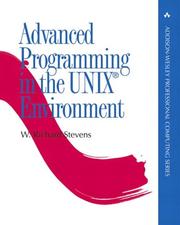
How long does it take to read Advanced Programming in the Unix Environment?
W. Richard Stevens, Stephen A. Rago
Advanced Programming in the Unix Environment by W. Richard Stevens, Stephen A. Rago takes about 17 hours 18 minutes to read at 250 words a minute.
About 17 hours 18 minutes
A long haul
First published 1992. 944 pages, about 259,600 words.
35 days (about 5 weeks) at 30 minutes a day
Estimate based on 275 words per page.
At other speeds
| Slow, 150 words a minute | 28 hours 51 minutes |
| Average, 250 words a minute | 17 hours 18 minutes |
| Fast, 400 words a minute | 10 hours 49 minutes |
The page count is the median across 15 editions, so your copy may differ. How we calculate.
About the book
Rago carefully retains the spirit and approach that made this book a classic. Building on Stevens' work, he begins with basic topics such as files, directories, and processes, carefully laying the groundwork for understanding more advanced techniques, such as signal handling and terminal I/O. Substantial new material includes chapters on threads and multithreaded programming, using the socket interface to drive interprocess communication (IPC), and extensive coverage of the interfaces added to the latest version of the POSIX. 1 standard. Nearly all examples have been tested on four of today's most widely used UNIX/Linux platforms: FreeBSD 5.2.1; the Linux 2.4.22 kernel; Solaris 9; and Darwin 7.4.0, the FreeBSD/Mach hybrid underlying Apple's Mac OS X 10.3. As in the first edition, you'll learn through example, including more than 10,000 lines of downloadable, ANSI C source code. More than 400 system calls and functions are demonstrated with concise, complete programs that clearly illustrate their usage, arguments, and return values. To tie together what you've learned, the book presents several chapter-length case studies, each fully updated for contemporary environments. Advanced Programming in the UNIX® Environment has helped ageneration of programmers write code with exceptional power, performance, and reliability. Now updated for today's UNIX/Linux systems, this second edition will be even more indispensable.
Subjects: Operating systems (Computers), UNIX (computer operating system), Computer programming, Computers, Systèmes d'exploitation (Ordinateurs), Operating systems